Walk into any hardware store — whether it’s a big-box retailer or a beloved local supplier — and you’re immediately confronted with a choice that has divided woodworkers, contractors, DIYers, and tradespeople for generations: reach for the plug, or reach for the handle?
Power tools vs. hand tools is one of those debates that sounds deceptively simple on the surface. In practice, it’s a nuanced decision shaped by the task at hand, your skill level, the scale of your project, your budget, and frankly, the kind of craftsperson you want to be. Neither category wins outright. Both have irreplaceable roles. The professionals who do their best work are those who understand exactly when to use each.
This guide breaks it all down — from definitions and core differences to real-world use cases, a full comparison table, and a clear decision framework you can actually use in the field.
What Are Power Tools?
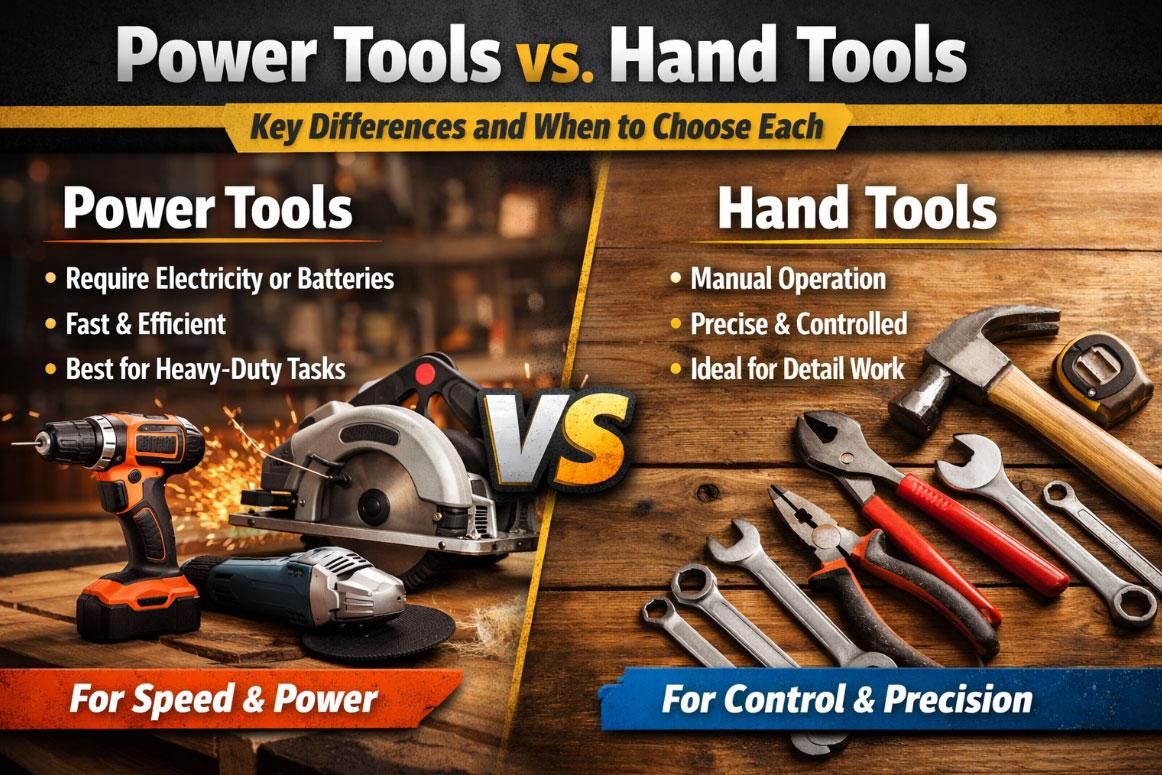
Power tools are any tools that use an external power source to operate — electricity (corded or battery), compressed air (pneumatic), or in some cases, combustion engines. They are designed to automate or accelerate the mechanical effort required for a task, converting energy into torque, oscillation, rotation, or reciprocating motion with minimal physical input from the user.
The modern power tool industry is enormous. According to industry estimates, the global power tools market is valued at well over $30 billion and continues to grow year on year. Brands like DeWalt, Milwaukee, Bosch, Makita, and Festool have built empires around the professional and prosumer segments, while budget brands serve the casual homeowner with tools in the $20–$80 range.
Common Examples of Power Tools
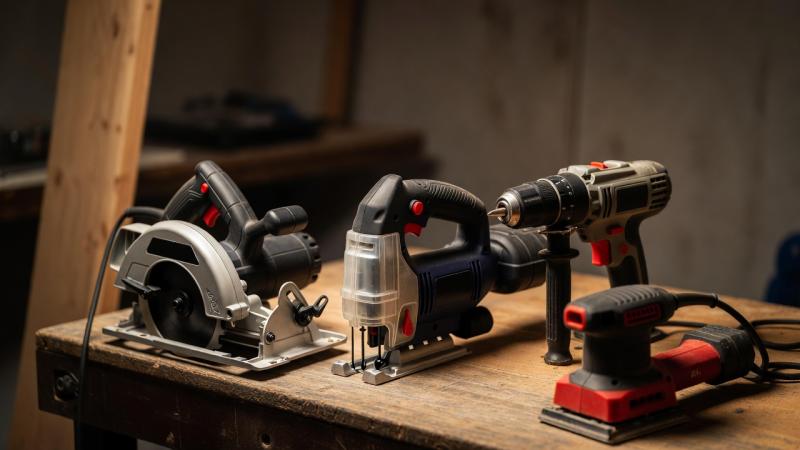
- Circular saws, miter saws, jigsaws, reciprocating saws
- Cordless drills and impact drivers
- Random orbital sanders, belt sanders
- Angle grinders, routers, planers
- Nail guns, brad nailers (pneumatic)
- Oscillating multi-tools
What Are Hand Tools?
Hand tools are the original toolkit. They are non-powered instruments that rely entirely on human force and dexterity to function. A hammer drives a nail through leverage and momentum. A hand plane shaves wood fibers through sharpness and pressure. A tenon saw cuts wood through repetition and technique. There are no motors, no batteries, no cords — just the craftsperson and the material.
Hand tools are not primitive relics. High-quality hand tools — Japanese chisels, a well-tuned wooden hand plane, a quality marking knife — represent centuries of refinement. A set of premium Lie-Nielsen hand planes can easily cost $500–$800 each, and skilled users will tell you they produce results no power tool can replicate. Their longevity, when properly maintained, is essentially indefinite.
Common Examples of Hand Tools
- Hammers, mallets, and sledgehammers
- Handsaws (rip, crosscut, dovetail, Japanese pull saws)
- Chisels, gouges, carving tools
- Hand planes (block, jack, smoothing, jointer)
- Screwdrivers, wrenches, pliers
- Marking gauges, squares, levels, measuring tapes
Power Tools vs. Hand Tools: The Full Comparison Table
Before diving into the nuanced decision-making, here is a comprehensive side-by-side breakdown across every major dimension that matters to a real-world user:
| Factor | Power Tools | Hand Tools | Edge |
|---|---|---|---|
| Speed | Very fast — motors eliminate manual effort and dramatically reduce task time | Slower on most tasks; speed depends on user skill and stamina | Power tools |
| Precision | High precision with jigs, guides, and fences; less tactile feedback | Exceptional precision in skilled hands; direct tactile connection to the material | Hand tools |
| Initial cost | $30–$800+ per tool; professional-grade sets can exceed $2,000 | $5–$500+ per tool; a functional starter kit costs $50–$150 | Hand tools |
| Running cost | Electricity or batteries; blade/bit replacements; servicing | Minimal; sharpening stones are inexpensive; no electricity needed | Hand tools |
| Noise | Loud to very loud; hearing protection almost always required | Near-silent; suitable for apartments, early mornings, shared spaces | Hand tools |
| Safety risk | Higher — spinning blades, electric shock risk, kickback potential | Lower overall, though sharp tools demand respect and technique | Hand tools |
| Portability | Cordless tools are very portable; corded tools need a power source | Fully portable; no power source needed anywhere on the planet | Hand tools |
| Skill floor | Low — many tasks are accessible to beginners with basic safety training | Higher learning curve; sharpening, stance, and technique all matter | Power tools |
| Skill ceiling | Moderate — tools do a lot of the work; mastery is about setups and jigs | Very high — mastery of hand tools reflects deep craft knowledge | Hand tools |
| Dust & debris | Heavy dust production; dust collection systems recommended | Minimal dust; shavings and chips are easy to manage | Hand tools |
| Maintenance | Brushes, motors, batteries, guards — more complex to service | Simple: keep blades sharp and metal rust-free | Hand tools |
| Best for large volumes | Absolutely — power tools scale with volume; hand tools do not | Not practical for high-volume or repetitive production work | Power tools |
| Best for joinery | Adequate with jigs; routers handle many joinery tasks well | Superior for mortise-and-tenon, dovetails, hand-cut joints | Hand tools |
| Space required | Stationary tools (table saw, bandsaw) need dedicated shop space | Most hand tools can be used on a workbench in a small space | Hand tools |
| Longevity | 5–15 years with regular use; batteries degrade after 3–5 years | Decades to lifetimes; antique hand planes still perform flawlessly | Hand tools |
| Environmental impact | Higher — energy consumption, battery disposal, manufacturing footprint | Very low — no electricity, no battery waste, highly repairable | Hand tools |
| Best scenario overall | Production work, home renovation, site work, speed-critical tasks | Fine woodworking, tight spaces, quiet work, skill-building, finishing | Context-dependent |
The Case for Power Tools
Let’s be honest: if you need to build a deck, frame a house, or cut 200 pieces of lumber to the same length by Friday afternoon, power tools are not optional — they are essential. The efficiency argument for power tools is overwhelming at any kind of scale.
A skilled carpenter with a circular saw can crosscut a piece of 2×4 in under three seconds. The same cut with a handsaw takes anywhere from 30 seconds to two minutes, depending on skill. Over hundreds of cuts on a job site, that difference in time compounds into hours, then days.
Pro tip: When building a power tool kit for the first time, prioritize a cordless drill/driver, a circular saw, and a random orbital sander. These three tools cover the vast majority of DIY and light construction needs and can be found in quality configurations for under $400 total.
Beyond raw speed, power tools democratize skilled work. A beginner with a cordless drill and the right bit can drive 100 screws accurately in an afternoon. A beginner attempting the same with a hand brace and auger will develop sore forearms and a deep respect for people who worked before the 20th century.
The cordless revolution — particularly the shift to lithium-ion battery platforms in the 2000s and the expansion of high-voltage systems (18V, 20V max, 40V, 60V, 80V) — has made power tools more portable and more powerful than ever. Today’s cordless circular saws, hammer drills, and reciprocating saws rival or surpass the performance of their corded predecessors from 15 years ago.
When Power Tools Are the Clear Choice
- Construction, framing, decking, and renovation projects
- Any task requiring repetition of the same cut or operation
- Cutting sheet goods (plywood, MDF, OSB) to size
- Driving large numbers of fasteners
- Sanding large surface areas
- Drilling into masonry, concrete, or steel
- Jobs where time is money (professional contractors)
The Case for Hand Tools
There is something almost philosophical about hand tool work. When a craftsperson takes a sharp chisel to a piece of hardwood and pares a mortise to a perfect fit, they are participating in a tradition that stretches back thousands of years. No motor can replicate the sensory feedback — the feel of the wood grain, the sound of a sharp plane iron, the slight resistance that tells you you’re cutting against the grain.
But sentimentality aside, hand tools offer concrete, practical advantages that power tools genuinely cannot match in specific situations.
“The finest furniture made before the industrial revolution was built entirely with hand tools. It is still standing. Some of it still fits together perfectly.”
Precision is the hand tool’s strongest card. A well-tuned wooden plane can take shavings thinner than a human hair. A sharp chisel in practiced hands can sneak up on a fit in a way that a router — however accurate — cannot. Fine furniture makers, luthiers building guitars and violins, boatbuilders, and chair makers frequently rely on hand tools for this reason. When you’re fitting a hand-cut dovetail joint that must close with hand pressure alone, the degree of control needed lives in the craftsperson’s hands, not in a machine.
Hand tools also excel in accessibility. A woodworker in a city apartment with no dedicated workshop can set up a small bench in a spare room, work in near-silence at any hour, and produce beautiful, precise work without disturbing a single neighbor. That same apartment dweller would struggle to justify a $700 track saw, a dust collector, and the noise complaints that follow.
When Hand Tools Are the Clear Choice
- Fine joinery: dovetails, mortise-and-tenon, hand-fitted joints
- Final surface preparation (hand planing before finishing)
- On-site work with no power access
- Quiet environments: apartments, late-night work, shared spaces
- Small-scale repairs and fittings where power tools are overkill
- Carving, sculpting, and decorative woodwork
- Teaching tool skills and developing fundamental technique
The sharpening argument: Hand tools are only as good as their edges. A dull chisel is more dangerous than a sharp one — it requires more force and is prone to slipping. Investing in a quality sharpening system ($30–$150 for waterstones or a honing guide setup) transforms hand tool work entirely.
The Real Decision Framework: When to Choose Each
The most useful mental model is not “power tools vs. hand tools” as opposing camps, but rather a task-by-task assessment based on four core variables: volume, precision, environment, and skill level.
Variable 1: Volume and Scale
If you need to make the same cut, hole, or operation more than five or six times, a power tool is almost always the correct choice. The setup time becomes worthwhile, the consistency improves, and the physical strain on the user drops dramatically. If you need to make a single mark or trim a single edge, a hand tool is often faster — no setup, no cords, just the cut.
Variable 2: Required Precision and Surface Quality
For rough cuts, structural work, and anything that will be covered or painted over, power tools are perfectly appropriate. For exposed surfaces, fine furniture, instrument-making, or any work where fit and finish are on display, hand tools frequently deliver a superior result — particularly for the final passes. Many experienced woodworkers use power tools to get close and hand tools to get perfect.
Variable 3: Environment and Constraints
Working on-site in the middle of a forest restoration project? You may have no power source. Working in a shared apartment at 10pm? Your neighbor’s ceiling and your relationship depend on keeping it quiet. Working in a small garage with no dust collection? Power tools will fill the space with fine particles in minutes, while hand tools produce manageable shavings. Environment is often the deciding factor professionals overlook when advising beginners.
Variable 4: Your Actual Skill Level
Power tools lower the skill floor for most tasks, which is why they’re excellent for beginners who need results now. But they raise the risk considerably — a beginner with a table saw without proper training is a genuine safety concern. Hand tools require more technique to use well but are generally more forgiving in terms of catastrophic accidents. Many woodworking teachers recommend beginners start with hand tools to develop an understanding of wood before adding the speed and noise of powered machinery.
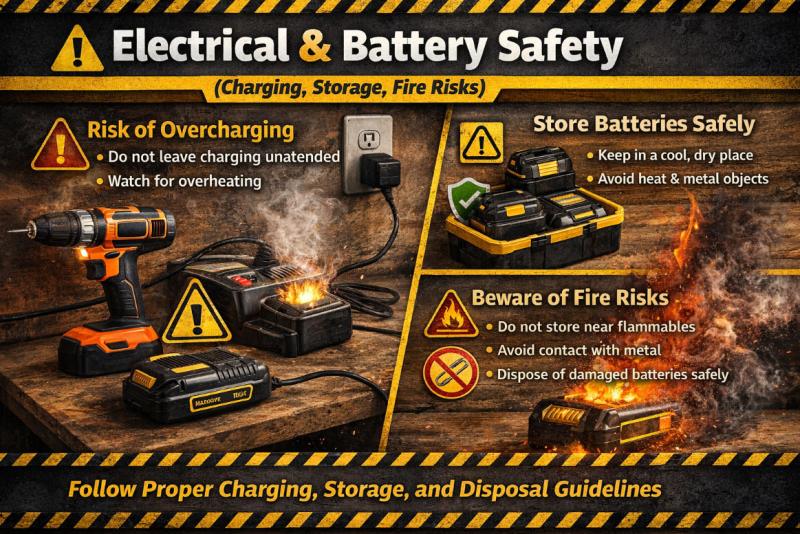
Safety note: Power tools account for tens of thousands of emergency room visits annually in the US alone. Table saws are particularly dangerous. Always use blade guards, push sticks, and appropriate PPE. Never bypass safety features to “make it easier.”
The Hybrid Approach: What Most Professionals Actually Do
Ask any experienced cabinetmaker, furniture maker, or finish carpenter which camp they belong to and you’ll usually get the same answer: both. The question is not which type of tool is better — it’s which tool is right for this specific step in this specific project.
A common professional workflow looks something like this: a miter saw or track saw breaks down lumber to rough length quickly. A jointer and thickness planer (both power tools) flatten and dimension stock. Then a table saw or router handles the majority of joinery setup. Finally, a hand plane smooths the faces, chisels refine the joints, and a card scraper takes the surface to the point where it needs no sandpaper at all.
This is not indecision — it is mastery. The ability to move fluidly between powered and unpowered tools, applying each where it has the greatest advantage, is what separates truly skilled craftspeople from those who are merely fast or merely traditional.
Best Approach by User Type
The DIY homeowner: Start with a cordless drill and a few quality hand tools: a hammer, chisels, and a handsaw. Add power tools as specific projects demand them.
The professional contractor: Heavy investment in power tools is justified by speed and volume. Hand tools kept for finishing, trim work, and on-site fixes that don’t warrant machine setup.
The fine furniture maker: Power tools for milling and dimensioning stock. Hand tools for joinery, fitting, and final surface preparation. Mastery of both is non-negotiable.
The apartment woodworker: Hand tools almost exclusively — noise, dust, and space constraints make power tools impractical for most tasks. A solid workbench and sharp tools are enough.
Costs: Building a Toolkit in Each Category
Budget is a real consideration, and the two categories have genuinely different cost structures — not just at the point of purchase, but over the lifetime of the tool.
A starter hand tool kit — hammer, set of chisels, handsaw, block plane, marking gauge, square, and tape measure — can be assembled for $100–$250 and will last decades with basic maintenance. You can spend far more ($500–$1,500) for premium brands like Lie-Nielsen, Veritas, or Japanese tool specialists, and those tools will likely outlast their owner. Running costs are minimal: a good set of sharpening stones costs $30–$80 and lasts for years.
A starter power tool kit — cordless drill/driver, circular saw, jigsaw, and random orbital sander — costs more, typically $300–$700 for a quality setup on a single battery platform. The ongoing costs are higher too: replacement blades and bits add up, batteries typically need replacement every 3–5 years (budget $80–$200 per battery), and eventually motors wear out. Professional-grade tool systems from Milwaukee, DeWalt, or Festool can see individual tools priced at $200–$600+.
Over a 20-year period, a well-maintained set of hand tools frequently costs less than a comparable set of power tools when all replacement parts, consumables, and energy costs are factored in.
The Sustainability Angle
It would be incomplete to discuss power tools vs. hand tools in 2026 without acknowledging the environmental dimension. Hand tools require no electricity, generate minimal waste, are fully repairable, and when made well, are effectively permanent. A hammer head can be rehung, a saw plate re-sharpened, a plane iron re-ground indefinitely.
Power tools, by contrast, consume electricity during use, rely on lithium-ion batteries that have a finite life cycle and present recycling challenges, and are frequently designed with components that are difficult or impossible to repair — particularly in the budget segment. The “throwaway drill” purchased for $35 and discarded after the motor dies is not an environmentally neutral transaction.
This is not an argument against power tools. It is an argument for buying quality tools, maintaining them, buying into battery platforms with long-term ecosystem support, and keeping hand tools in your kit even as you invest in powered alternatives.
Final Verdict
The power tools vs. hand tools debate is, ultimately, a false binary. The craftsperson who dismisses power tools as brute machines misses the extraordinary capability they offer for speed, scale, and accessibility. The contractor who dismisses hand tools as anachronistic novelties leaves precision, silence, and longevity on the table.
The right answer — the answer that the best builders, makers, and craftspeople in every trade have always arrived at — is: use both. Learn both. Sharpen your chisels and charge your batteries. Know when a problem calls for the smell of sawdust from a hand plane and when it calls for a 12-inch miter saw and a deadline.
That dual fluency is not a compromise. It is the whole point.
This article is intended for educational and informational purposes. Tool prices cited are approximate USD market rates as of early 2026 and may vary by region and retailer. Always follow manufacturer safety guidelines when operating any power tool.