What Are Router Bits?
A router bit is the cutting accessory that fits into a woodworking router. It attaches via the router's collet — a tightened chuck that grips the bit's shank — and spins at high RPM to cut, shape, or profile your workpiece. The bit does the actual work; the router just powers it.
Every router bit has three main parts: the shank (the smooth cylindrical shaft that fits into the collet), the body (which supports the cutters and adds mass for stability), and the cutting edges themselves. On many bits, you'll also find a pilot bearing — a small wheel near the cutting edge that rides along the surface of the material to keep the cut consistent and accurate.
Router bits work on a wide range of materials. Wood — hardwood, softwood, and sheet goods like plywood and MDF — is the most common. But many bits are also effective on plastics and certain composite materials. The key is matching the right bit to the right material and task.
Carbide vs. High-Speed Steel: What Your Bits Are Made Of
Before diving into types, it's worth understanding what router bits are made from, because it affects everything from cut quality to how long the bit lasts.
Carbide-tipped bits are the gold standard for most woodworkers. They hold their edge significantly longer than steel, run cleaner through hardwoods, and are less likely to scorch or char the surface of your material. Most professional-grade bits use carbide inserts brazed onto a steel body. The carbide is usually thick enough to be resharpened multiple times, which extends the life of the bit considerably.
High-speed steel (HSS) bits are more affordable upfront and still adequate for light, occasional use. They dull faster, especially in hardwoods, and require more frequent sharpening. If you're doing a one-off project or experimenting with routing for the first time, HSS can get you started without a big investment.
Solid carbide spiral bits take things a step further — the entire cutting portion is a single piece of carbide with helical flutes ground into it. These are common in CNC machining and deliver exceptional finish quality and chip evacuation.
The Main Types of Router Bits
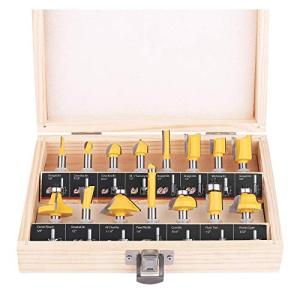
Router bits fall into two broad families: straight-cutting bits, which remove material from inside or along the edge of a workpiece, and edge-forming (profile) bits, which shape the outside profile of an edge for decorative or functional purposes. Within those two families, there are dozens of specific profiles. Here are the ones you'll use most.
Straight Bits
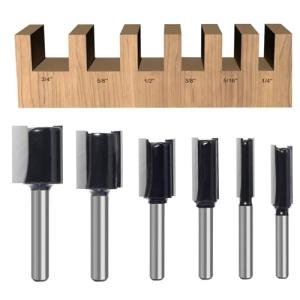
The workhorse of the router bit world. Straight bits cut directly into the material to form grooves, dados (channels cut across the grain), slots, and mortises. They're available in a wide range of diameters — typically from 3/16" up to 1-1/2" — and can be used in handheld routers or mounted in a router table. If you only buy one type of bit, start here.
Spiral Bits (Upcut, Downcut, and Compression)
Spiral bits look like small drill bits but are designed for horizontal cutting. The direction of the spiral matters a lot:
- Upcut spiral bits pull chips upward and out of the cut, keeping the channel clean. They're excellent for mortising and deep grooves but can cause some tearout on the top surface of the workpiece.
- Downcut spiral bits push chips downward, which leaves a cleaner top edge — ideal for veneered panels or whenever surface appearance matters.
- Compression bits combine both: an upcut section at the bottom and downcut at the top, giving you clean edges on both faces. These are popular with CNC machines and for cutting plywood or laminated panels.
Flush Trim Bits
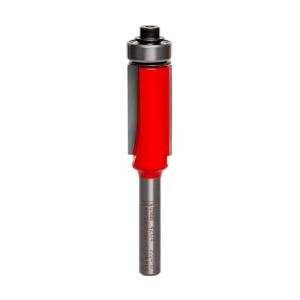
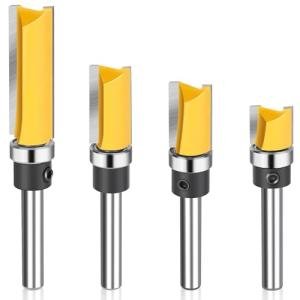
Flush trim bits have a pilot bearing (usually at the tip or the top) that rides along a template or an existing edge. The cutter trims the workpiece flush with whatever the bearing is following. This is invaluable for duplicating parts, trimming laminate, or cleaning up the edges of template-routed pieces. It's one of those bits that once you use it, you wonder how you managed without it.
Rabbeting Bits
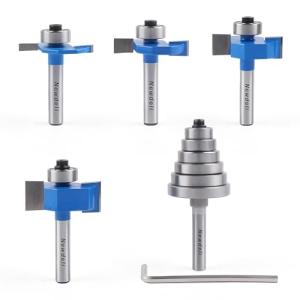
A rabbeting bit cuts a step — called a rabbet — along the edge of a board. This is a classic joint used in drawer construction, cabinet backs, and picture frames. Most rabbeting bits come with a set of interchangeable bearings of different diameters, which lets you adjust the depth of the rabbet without buying multiple bits. One bit, multiple functions.
Roundover Bits
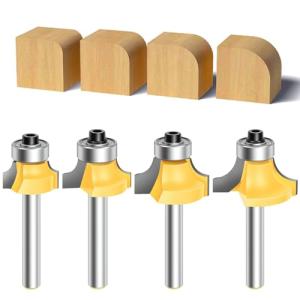
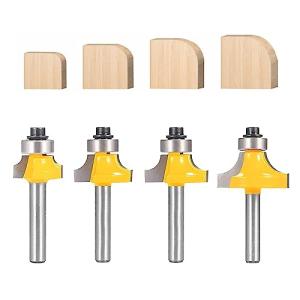
Exactly what the name says: these bits soften a sharp edge into a smooth, rounded profile. They're used on table edges, cabinet doors, shelf edges, and anywhere you want to eliminate that sharp 90° corner. The radius you choose — 1/8", 1/4", 3/8", or larger — determines how pronounced the curve is.
Chamfer Bits
A chamfer bit cuts a flat, angled bevel along an edge, typically at 45°. Chamfers are clean and modern-looking — great for contemporary furniture and cabinetry. They also work well as a decorative detail on the underside of table aprons or along drawer faces.
Cove Bits
Cove bits cut a concave, curved profile into an edge — the opposite of a roundover. They're used to create classical molding profiles, decorative edges on furniture, and transitional shapes in architectural millwork. Combined with a roundover, you can produce complex molding profiles entirely with a router.
Roman Ogee Bits
The Roman ogee is a classic woodworking profile: an S-shaped curve that transitions from a small step into a concave arc. It's been used in furniture-making for centuries and gives pieces a refined, traditional character. These bits are used on table edges, cabinet doors, fireplace surrounds, and anywhere a touch of classical elegance is wanted.
Dovetail Bits
Dovetail bits cut the angled profile used in dovetail joints — one of the strongest and most visually appealing joints in woodworking. They're used in conjunction with a dovetail jig to cut both the pins and tails of the joint in drawers, boxes, and case furniture. Dovetail bits are also used to cut sliding dovetail joints, where a matching channel locks two pieces together with exceptional mechanical strength.
Panel Raising Bits
These are large-diameter bits used primarily in router tables (they're too aggressive for handheld use). A panel raising bit shapes the raised field on a cabinet door panel — creating that classic recessed-center, raised-border look of traditional frame-and-panel doors. Because of their size, they need to be run at lower RPM settings.
Slot-Cutting Bits
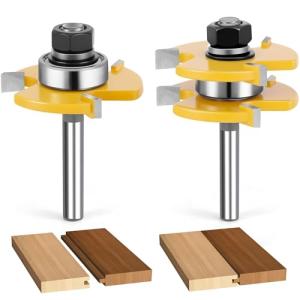
Slot cutters (also called biscuit slot cutters or groove cutters) cut narrow horizontal grooves along the face or edge of a board. These slots can accept biscuits for alignment during glue-ups, splines for added strength, or decorative inlays. They're mounted on an arbor and can be stacked with spacers to vary the width of the cut.
Shank Size: 1/4" vs. 1/2" — Does It Matter?
Yes, it matters more than most beginners expect.
1/4" shank bits are smaller, lighter, and more affordable. They work fine in compact trim routers and are suitable for lighter-duty work and detail profiles. However, they produce more vibration and are more prone to deflection during heavy cuts.
1/2" shank bits are more rigid, vibrate less, and deliver a noticeably cleaner cut — especially in hardwoods and on longer passes. If your router accepts 1/2" shanks, use them whenever possible. The difference in cut quality is real and worth the slightly higher price.
How to Choose the Right Router Bit for Your Project
With hundreds of profiles and sizes available, the choices can feel overwhelming. Here's a simple way to approach it:
Start with the cut type. Are you removing material from the interior of a board (groove, dado, mortise)? You want a straight or spiral bit. Are you shaping the edge of a board? You want a profile bit — roundover, chamfer, cove, ogee, etc. Are you jointing two pieces together? You want a joinery bit — rabbeting, dovetail, or slot cutter.
Match the shank to your router. Check your router's collet size and buy bits accordingly. Don't try to use a 1/2" shank bit in a 1/4" collet.
Think about material. Carbide-tipped bits handle hardwoods, plywood, and MDF comfortably. If you're routing softwoods only, HSS can be adequate for occasional use. For plastics, use bits designed for the purpose — standard wood bits can work but may melt rather than cut some materials.
Consider whether you need a pilot bearing. Edge-forming bits typically have a bearing that guides the cut. If you need to follow a template or route a freehand edge, the bearing is essential. For interior routing (grooves, dados), no bearing is needed — you guide the cut with a fence or template instead.
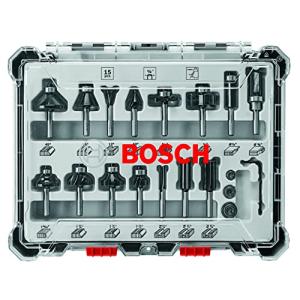
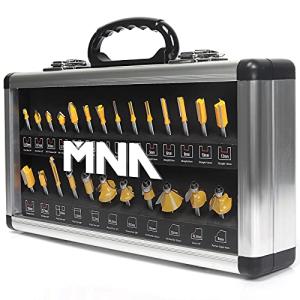
Think about sets vs. individual bits. For beginners, a starter set with 10–15 common profiles is an efficient way to discover what you use most. Over time, replace the most-used bits with premium individual versions. Buy cheap to learn; buy quality to keep.
Router Bit Safety: A Few Non-Negotiables
Router bits spin at anywhere from 8,000 to 25,000 RPM. That demands respect.
Always wear eye protection and hearing protection. Disconnect power before changing bits. Feed the router in the correct direction (against the bit's rotation, not with it) — feeding the wrong way is called climb-cutting and can snatch the router out of your hands. Use multiple shallow passes rather than trying to hog out the full depth in one go. Larger bits require slower RPM settings — most variable-speed routers have guidelines for this.
Let the bit come to a complete stop before setting the router down or reaching near the cutter.
Caring for Your Router Bits
Quality router bits are an investment, and a little maintenance goes a long way. After use, clean off pitch and resin with a dedicated bit-cleaning solution — buildup causes friction and heat, which dulls the cutting edges faster. Store bits in a case, block, or individual sleeves so the carbide edges don't contact each other or other metal tools. Keep them dry to prevent rust on the shank and body.
Most carbide-tipped bits can be professionally resharpened several times before they're worn out. It's usually cheaper to resharpen a quality bit than to replace it.
Building Your Router Bit Collection
You don't need every bit on day one. A solid starter collection for a general woodworker might include:
- A straight bit (or two, in 1/4" and 1/2" diameter)
- A flush trim bit for template work and laminate trimming
- A roundover bit in 1/4" or 3/8" radius
- A rabbeting bit with interchangeable bearings
- A 45° chamfer bit
- A cove bit for molding profiles
- A Roman ogee bit for decorative detail work
From there, add joinery bits as your projects demand them. Let the work guide your purchases rather than trying to own every profile before you've needed any of them.
Router bits are, at their core, about possibility. The right bit transforms a flat-edged board into something with character — a softened curve, a crisp bevel, a decorative groove, a joint that locks together with precision. They're not complicated tools, but understanding them well is one of the clearest paths to better, more confident woodworking.