Why Accurate Measurement Actually Matters
It's easy to underestimate the downstream effect of a measurement error. A wall stud that's off by a centimetre might seem trivial until the drywall doesn't line up. Floor tiles that aren't properly squared to the room look wrong even to an untrained eye, even if the observer can't explain exactly why. A fence post that's slightly out of plumb will only become more obviously wrong as the fence panels go up.
Measuring tools aren't just about getting a number. They're about establishing the truth of a space — the true horizontal, the true vertical, the true distance, the true angle. From that foundation of truth, everything else follows cleanly. Layout tools take that a step further, helping you transfer measurements across a surface, mark reference lines, and set up a project before the physical work begins.
In professional trades — carpentry, tiling, bricklaying, electrical work, plumbing, steelwork — measurement accuracy isn't a nice-to-have. It's a professional standard. The tools in this category are what let tradespeople meet that standard consistently, day after day, job after job.
Tape Measures and Retractable Rules
The tape measure is probably the most-reached-for tool in any toolbox. Simple in concept, but deceptively varied in practice. The best tape measures share a few key qualities: a strong, flexible blade that holds its shape extended without buckling, a durable casing that survives drops onto concrete, a reliable lock mechanism, and clear, easy-to-read markings in both metric and imperial.
Blade width matters more than people realise. A wider blade — 25mm or 32mm — stands out further before it starts to sag, which means you can take solo measurements across longer spans without the tape collapsing on you. For joinery and detailed finish carpentry, a narrower, more flexible blade can be easier to hook into tight corners.
Beyond the standard retractable tape, there are open-reel fibreglass tapes designed for long outdoor measurements — surveying plots, laying out foundations, measuring fields. These give you lengths up to 50 or even 100 metres with consistent accuracy. For everyday workshop use, a good 5-metre or 8-metre steel tape is the workhorse you'll reach for constantly.
Spirit Levels and Digital Levels
A level is what separates a professional finish from an amateur one. Spirit levels — the classic design with a sealed vial of liquid and an air bubble — come in lengths from short torpedo levels of 230mm up to long box levels of 1800mm or more. The longer the level, the more accurate the reading over a given surface, because small deviations get averaged out.
For most trades, a good 600mm or 1200mm aluminium box level covers the vast majority of needs. Look for machined edges (not just cast), multiple vials for plumb, level and 45-degree readings, and vials that are bright and easy to read in poor light.
Digital levels take the same principle and add an electronic inclinometer, showing the angle of a surface on a display rather than asking you to eyeball a bubble. For precision work — setting machinery, aligning solar panels, grading drainage runs — a digital level gives you readings accurate to a fraction of a degree that a spirit level simply can't match.
Line levels are the lighter-duty option: small vials designed to hang on a string line, used for establishing level references across longer distances. They're the classic tool for levelling fence posts or brickwork courses over a run of many metres.
Laser Levels and Laser Distance Measurers
Laser tools have genuinely transformed the way measuring and layout work gets done. What used to require two people — one to hold a reference point, one to mark the line — can now be done by a single person in a fraction of the time.
A laser level projects a beam of laser light across a surface, giving you a reference line that's automatically level (or plumb, depending on orientation). Self-levelling laser levels are the most practical: place them roughly in position, and an internal pendulum mechanism finds true level automatically. Cross-line lasers project both horizontal and vertical beams simultaneously, creating a perfect cross-hair reference on your work surface. Rotary laser levels are the heavy-duty option for outdoor work — they spin the beam to project a level plane around the entire room or worksite.
Laser levels are invaluable for tiling, fitting suspended ceilings, installing kitchen cabinets, setting out stud walls, and any task where a consistent reference line needs to extend across a large area quickly.
Laser distance measurers solve a different problem: getting accurate distance readings quickly, especially in spaces where a tape measure is awkward. Point at a wall and press a button — the tool bounces a laser off the surface and gives you a reading in a fraction of a second, accurate to within a millimetre or two. Modern models calculate area and volume automatically, store multiple measurements, and add or subtract distances at the press of a button. For surveyors, estimators, architects, and anyone who spends time measuring rooms, they pay for themselves within a few jobs.
Squares, Angles, and Marking Tools
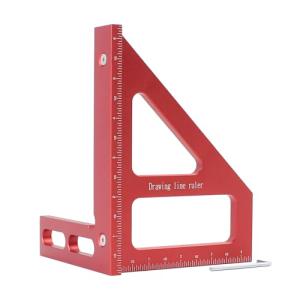
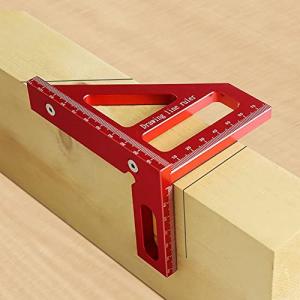
Getting lines square to each other, or at a specific angle, is where layout tools really come into their own. A combination square is one of the most versatile tools in this category — it combines a sliding ruler with a fixed 90-degree and 45-degree reference, a spirit level, and a scriber. Carpenters, metalworkers, and joiners use them constantly for marking cut lines, checking squareness, setting depths, and testing flatness.
Try squares and engineering squares are designed purely for checking and marking right angles. The quality of a square matters enormously — a cheap square that's slightly off 90 degrees will compound errors across every component you mark with it. Precision-ground squares hold their accuracy across years of hard use.
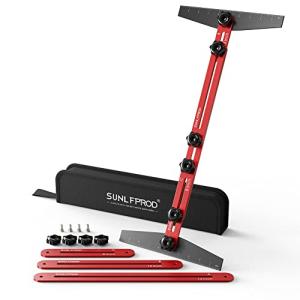
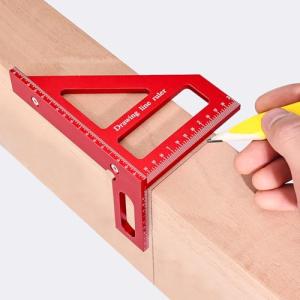
Speed squares are the go-to tool for roof carpentry and framing, allowing rapid marking of cut angles, rafters, and stud positions. Sliding bevel gauges let you capture any angle from a reference surface and transfer it to your workpiece — essential for cutting mitres on unusual angles or working with non-standard roof pitches.
Protractors and digital angle finders extend this further, giving you precise numerical angle readings rather than asking you to set by eye. For cutting complex mitres on a compound mitre saw, for example, knowing the exact angle digitally eliminates guesswork.
Chalk lines are the layout tool for marking long straight reference lines across floors, walls, and roofs. Snap a chalk line and you have an instant straight reference that covers metres in a single action — far faster than marking a line by hand. Chalk lines are indispensable for tiling, roofing, flooring, and any large-area layout work.
Marking and Scribing Tools
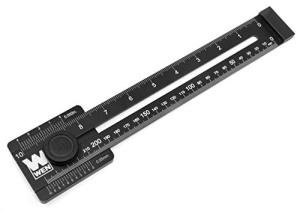
A measurement is only as useful as the mark you make from it. Pencils, marking knives, chalk markers, and scribers are all part of the measuring and layout toolkit. Marking knives leave a fine, precise cut line that's more accurate than any pencil — important for joinery where fractions of a millimetre count. Chalk markers deposit a removable, highly visible line on surfaces like glass, tiles, and dark materials where pencil marks simply don't show up.
Profile gauges (also called contour gauges or scribers) are clever tools that conform to an irregular profile — the edge of a tile around a pipe, for instance — and then hold that shape so you can transfer it to the piece you're cutting. What would otherwise require multiple careful measurements and freehand marking becomes a simple trace.
Choosing the Right Measuring Tools for Your Trade
Not every project needs every type of measuring tool. A decorator fitting skirting boards needs a good tape measure, a spirit level, and possibly a laser level for marking a horizontal reference line. A structural engineer or surveyor needs precision instruments with documented calibration.
The key questions to ask are:
How precise does the measurement need to be? Rough carpentry and fine joinery have very different tolerance requirements. A 2mm error in rough framing is insignificant; in cabinet making, it's a problem.
How often will you use it? For a tool you'll use daily, investing in quality pays back quickly through durability, speed, and confidence in your results. For occasional use, a mid-range option is usually perfectly adequate.
What environment are you working in? Outdoor construction work demands tools that handle knocks, dust, and water. IP-rated laser measurers and reinforced levels are worth the extra cost when the alternative is a broken tool on a muddy site.
Caring for Your Measuring Tools
Even the best measuring tools need a little care to stay accurate. Tape measures should be wiped clean regularly — grit and adhesive residue on the blade makes it difficult to read and accelerates wear on the casing. Spirit levels should never be stored resting on their edges unsupported; the vials can be knocked out of calibration by a bad impact.
Laser levels and digital tools should be checked periodically against a known reference and recalibrated if necessary. Many self-levelling laser levels have a visible indicator when the unit is outside its self-levelling range — always check this before relying on a reading.
Squares are worth checking occasionally by marking a line, flipping the square, and marking again — if they don't align exactly, the square has drifted and should be replaced or reset.
Measuring and layout tools might not be the most exciting part of a toolkit, but they are absolutely the most foundational. Every other skill — the cutting, the fitting, the finishing — depends on the accuracy that these tools provide. Buy well, use correctly, and look after them, and a good set of measuring tools will serve you reliably for years.