What Is a Ratchet Wrench?
A ratchet wrench — sometimes called a ratcheting spanner or a flex-head ratchet — is a hand tool designed to tighten or loosen nuts and bolts using a ratcheting mechanism. Unlike a standard open-end or combination wrench, a ratchet wrench allows continuous rotation of the fastener without removing the tool from the head. You push in one direction, the wrench bites and turns. You pull back, the teeth disengage and reset. Repeat until the job is done.
Most ratchet wrenches combine a fixed wrench profile on one end with a ratcheting box end on the other, giving you versatility without doubling your toolbox. The ratcheting end typically features a low-profile gear mechanism with anywhere from 36 to 120 teeth — the more teeth, the smaller the arc of swing you need to engage the mechanism. In tight spaces, that difference is everything.
How Does a Ratchet Wrench Work?
The core of every ratchet wrench is a pawl-and-gear system. Inside the ratcheting head sits a hardened steel gear cut with evenly spaced teeth. A small spring-loaded pawl — a notched lever — presses against those teeth. When you rotate the wrench in the working direction, the pawl locks against the gear and transfers your torque to the fastener. Rotate back, and the pawl skips over the teeth, releasing without transmitting force.
A small reversing switch or lever on the head flips the direction the pawl engages, letting you switch between tightening and loosening without ever taking the wrench off the bolt. This is the move that saves you minutes on every job.
Modern ratchet wrenches often feature:
- Flex heads that pivot to reach angled or recessed fasteners
- Fine-tooth mechanisms (72-tooth, 84-tooth, even 120-tooth) for minimal swing arc
- Low-profile heads that fit into narrow gaps where standard ratchets won't go
- Combination profiles with a fixed open end opposite the ratcheting box end
Types of Ratchet Wrenches
Not all ratchet wrenches are built for the same job. Understanding the different styles helps you pick the right tool before you're already knuckle-deep in an engine bay.
Combination Ratchet Wrenches
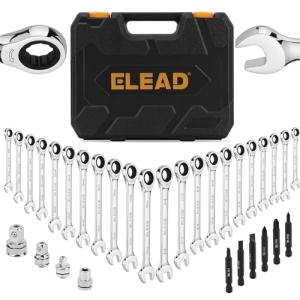
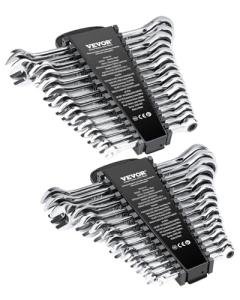
The most common type you'll find. One end is a standard open-end wrench for quick positioning; the other is a ratcheting box end for driving. They come in matched sets spanning the most common metric and SAE sizes and are the go-to choice for automotive work, bicycle maintenance, appliance repair, and general mechanical tasks.
Flex-Head Ratchet Wrenches
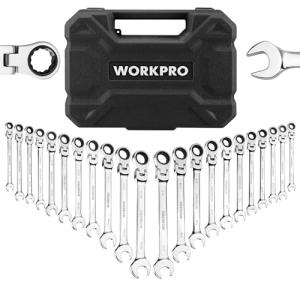
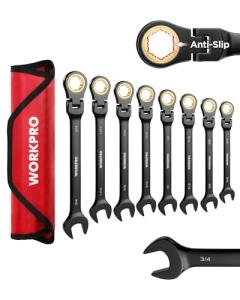
The flex-head design adds a pivoting joint between the handle and the ratcheting box end. This lets you approach fasteners from an angle — typically anywhere from 0° to 180° — making it possible to reach recessed bolts that a straight-head wrench can't access cleanly. If you work on vehicles regularly, a flex-head set is worth every penny.
Stubby Ratchet Wrenches
Short-handled ratchet wrenches built for extreme close-quarters work. Where a full-length wrench won't fit between a bracket and a hose, a stubby gets in, grabs the fastener, and cranks. Less torque leverage than a standard wrench, but in confined spaces, it's the only wrench that works at all.
Double-Ratcheting Wrenches
Ratchet mechanisms built into both ends of the wrench rather than combining open-end and ratcheting profiles. Useful when you know you'll be doing high-volume fastener work and want the ratcheting advantage on both ends.
Offset Ratchet Wrenches
The head is set at an offset angle relative to the handle, allowing clearance over surrounding components while still getting a clean grip on the fastener. Common in plumbing, HVAC work, and automotive engine work where you're fighting awkward geometry.
Choosing the Right Ratchet Wrench Set
Metric vs. SAE Sizing
If you work on European or Japanese vehicles, metric sizing (millimetres) covers most of what you'll encounter. American vehicles — particularly older ones — lean heavily on SAE sizing (fractional inches). In practice, most professional mechanics keep both on hand. A comprehensive ratchet wrench set covering 8mm through 19mm metric and 5/16" through 3/4" SAE handles the vast majority of automotive fasteners.
Tooth Count Matters More Than You Think
The tooth count on the ratcheting gear directly determines the minimum arc of swing you need to advance the fastener. A 36-tooth ratchet requires 10 degrees of swing. A 72-tooth mechanism drops that to 5 degrees. A 120-tooth design gets as low as 3 degrees. In a tight engine bay where your swing arc is limited by a firewall or a coolant hose, those extra teeth are the difference between getting the bolt loose and reaching for a different tool entirely.
Handle Length and Torque
Longer handles give you more torque leverage — useful when breaking loose a stuck fastener. Shorter handles sacrifice leverage but gain access. A mid-length handle (around 6–8 inches for common sizes) is the practical compromise for most work. For stubborn fasteners, combining a ratchet wrench with a breaker bar or torque wrench for the initial break is the smarter play anyway.
Steel Quality and Finish
Look for ratchet wrenches forged from chrome vanadium steel (Cr-V) or chrome molybdenum steel (Cr-Mo). Both offer excellent strength-to-weight ratios and resist corrosion well. Polished chrome finishes are easy to clean and resist rust. Satin or matte finishes reduce glare in bright shop lighting and hide tool marks better over time. Avoid stamped steel tools — the strength simply isn't there for serious fastener work.
Drive Direction Switch
The reversing mechanism should be easy to flip with one hand, ideally with a thumb-accessible lever or a simple push-button switch. You shouldn't have to set down the wrench or use two hands to change direction mid-job.
Where Ratchet Wrenches Outperform Other Tools
Ratchet wrenches don't replace every tool in your collection — but they outperform everything else in specific situations.
Tight spaces where a socket ratchet won't fit: Socket ratchets are bulky. The ratcheting head on a wrench sits directly over the fastener, adding almost no extra height. That matters enormously under a dashboard, inside a wheel well, or when accessing bolts tucked behind brackets.
Speed on repetitive fastening work: Assembly and disassembly jobs that involve running down dozens of the same bolt — brake caliper bolts, valve cover bolts, exhaust manifold bolts — go dramatically faster with a ratchet wrench than with a standard spanner.
Avoiding rounding off fastener heads: Because the ratchet wrench stays engaged on the fastener throughout the stroke, there's less tendency to slip and round off the corners. This is especially important on older, potentially corroded hardware.
Working at awkward angles: A flex-head ratchet wrench approaches fasteners from angles that would require multiple different standard wrenches to address. One tool, many angles.
Professional vs. DIY Ratchet Wrenches
There's a meaningful quality gap between entry-level and professional-grade ratchet wrenches, and it shows up in three places: the feel of the ratchet mechanism, the durability of the reversing switch, and the long-term tolerance of the gear teeth.
Entry-level sets (typically under €30–€50 for a set) are fine for occasional home use, light repair work, or situations where the wrenches mostly live in a junk drawer. The ratcheting mechanisms are functional but often feel gritty, and the reversing levers can loosen over time.
Mid-range sets from established tool brands hit the sweet spot for serious home mechanics and semi-professional use. Better steel, tighter gear tolerances, smoother action, and more reliable switches. This is where most people should be spending their money.
Professional-grade sets from brands catering to full-time mechanics are built to survive daily heavy use for years. The ratcheting action is silky smooth, the tooth counts are high, the finishes are more refined, and the lifetime warranties are actually backed by real service. If wrenches are in your hands every working day, the premium is worth it.
Care and Maintenance
Ratchet wrenches are low-maintenance tools, but a little attention extends their life significantly.
Keep the mechanism clean. Grit and metal particles work their way into the ratcheting head over time, degrading the action. Periodically flush the head with a light penetrating oil or a dedicated tool cleaner, work the mechanism back and forth, and wipe away the debris.
Lubricate the gear. A small amount of lightweight grease or oil on the ratchet teeth keeps the mechanism running smoothly and protects against corrosion. Don't over-apply — excess lubricant attracts dirt.
Store them properly. Ratchet wrench sets stored in a roll-up pouch, a wall rack, or a foam-lined drawer stay organised, don't clatter against each other, and are much easier to grab quickly. More importantly, the teeth and reversing mechanism don't get damaged from rattling around loose.
Don't use them as breaker bars. Ratchet wrenches are designed for moderate torque. Using a pry bar or pipe extension to get extra leverage on a ratchet wrench strains the mechanism, bends the handle, or strips the teeth. For high-torque situations, reach for the right tool.
Building the Right Ratchet Wrench Kit
If you're starting from scratch, here's a practical foundation:
A combination ratchet wrench set covering 8mm through 19mm in metric and 3/8" through 3/4" in SAE handles virtually every common automotive fastener. Add a flex-head set in the most common sizes (10mm, 12mm, 13mm, 14mm, 15mm metric) for engine bay work. Throw in a pair of stubby ratchet wrenches in the two or three sizes you reach for most, and you have a kit that covers roughly 95% of fastener jobs you're likely to face.
From there, specialised additions — offset heads, extra-long handles, microfinish ratchets for precision work — fill in specific gaps as your projects demand them.
The ratchet wrench doesn't look like much. It sits in the toolbox quietly, waiting. But once you've used a quality ratchet wrench in a confined space — felt the smooth click of the mechanism, driven a bolt home without repositioning the tool once — you understand why experienced mechanics reach for it first. It's one of those tools that changes how you work, not just how fast.