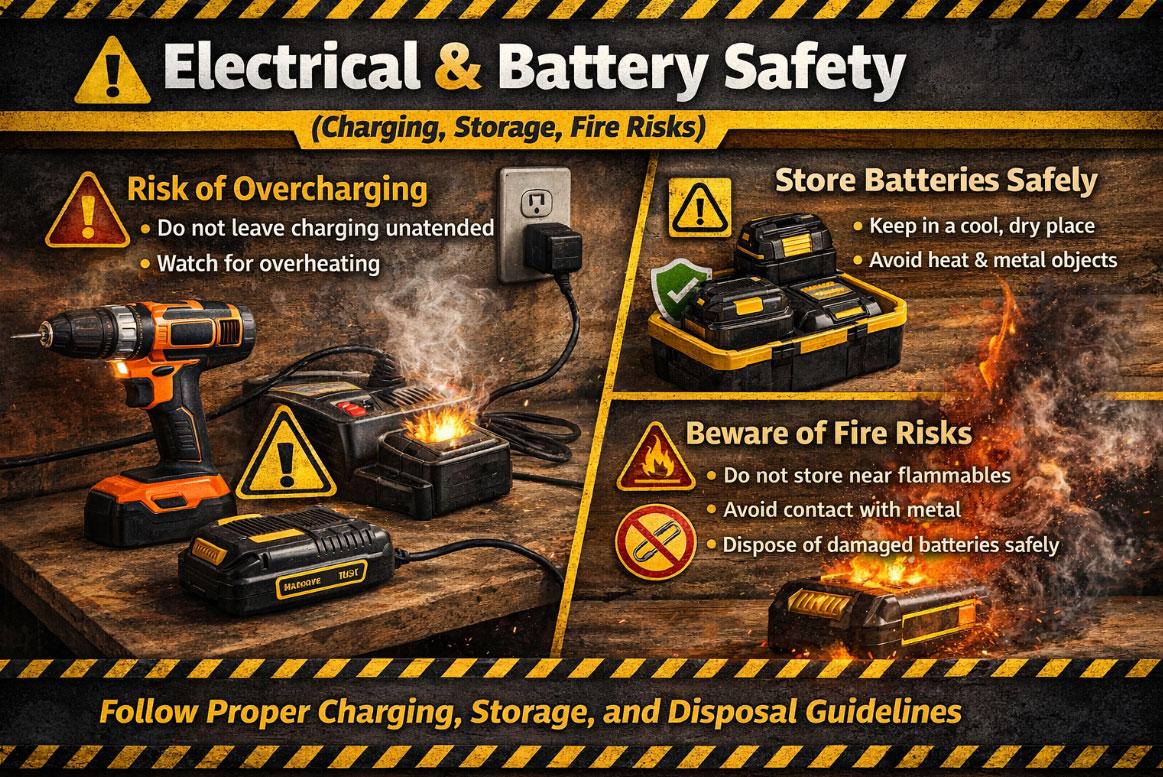
Every year, thousands of house fires are traced back to a phone left charging overnight, a vape battery stored loose in a pocket, or a lithium-ion pack tucked away in a hot garage. These are not freak accidents. They are predictable, preventable outcomes of ignoring the basics of electrical & battery safety — a subject that's grown more urgent as our lives run increasingly on rechargeable power.
We carry more stored energy on our persons today than a soldier in the field did a generation ago. Your laptop, your e-bike, your earbuds, your smart watch — each one is a compact electrochemical system operating under pressure, heat, and constant charge cycles. Treat them right, and they serve you for years. Treat them carelessly, and the consequences range from a ruined device to a gutted home.
This guide covers everything: how to charge correctly, where and how to store batteries safely, and how to recognize — and prevent — the fire risks that nobody talks about until it's too late.
Why Electrical & Battery Safety Has Never Mattered More
The global lithium-ion battery market is projected to exceed $130 billion by 2030. That's a staggering volume of energy-dense chemistry moving into homes, vehicles, and workplaces at a pace that safety education has struggled to keep up with.
Consider the scale: the U.S. Consumer Product Safety Commission (CPSC) receives thousands of reports annually involving battery-related incidents — fires, explosions, and chemical burns linked to consumer electronics, e-scooters, hoverboards, and power tools. The UK's London Fire Brigade has noted that e-bike and e-scooter fires are among the fastest-growing categories of residential fires, with incidents doubling year over year in some boroughs.
The chemistry behind these risks is straightforward. Lithium-ion cells store enormous amounts of energy in a small space. When that energy is released in an uncontrolled way — through physical damage, overcharging, heat, or manufacturing defects — the result is thermal runaway: a chain reaction in which the battery heats itself faster than it can dissipate heat, culminating in fire or explosion.
Understanding this isn't fearmongering. It's physics. And physics can be managed.
The Science of What Can Go Wrong
Before getting into practical rules, it helps to understand the enemy. Lithium-ion batteries consist of an anode, a cathode, an electrolyte, and a separator. The separator is the thin membrane that keeps the positive and negative sides apart. When it fails — due to puncture, excessive heat, or overcharge — the result is a short circuit that can generate temperatures exceeding 600°C (1,112°F) in seconds.
Thermal runaway is the term for this cascading failure. Once it starts, it almost cannot be stopped. The battery vents flammable gases, those gases ignite, and nearby cells often catch as well. This is why a single failing cell in a battery pack can destroy the entire unit — and anything near it.
Four main triggers initiate thermal runaway:
1. Mechanical damage — dropping a battery, crushing it, or puncturing it deforms the separator. This is why a swollen, dented, or cracked battery must be treated as an active hazard.
2. Overcharging — pushing a cell beyond its maximum voltage limit stresses the cathode chemistry. Consumer chargers are designed to prevent this, but counterfeit or damaged chargers bypass these protections.
3. Over-discharging — draining a cell below its minimum voltage threshold damages it permanently and makes subsequent charging unstable.
4. Heat exposure — ambient temperatures above 40–45°C (104–113°F) accelerate chemical degradation and increase failure risk dramatically.
Charging Safety — The Rules That Actually Matter
Charging is the most common context in which electrical & battery safety failures occur. The reason is simple: it's the moment when electrical energy is actively entering a battery, and it's often done unattended, overnight, in enclosed spaces.
Use the Right Charger — Always
This sounds obvious, but it's violated constantly. The "right charger" means the one designed for your specific device, or one that matches the voltage, current, and protocol specifications exactly. A charger that delivers more current than a battery is rated for will degrade it faster and increase the risk of overheating.
Counterfeit chargers are a particular hazard. Studies have found that a significant proportion of third-party phone chargers sold online lack basic safety certifications and fail standard tests for insulation resistance and overload protection. If a charger costs $3 when the manufacturer's original costs $25, the price difference is almost certainly safety engineering.
Practical rule: Buy replacement chargers only from the device manufacturer or established electronics retailers. Check for safety certification marks — CE, UL, or equivalent for your region.
Don't Charge Unattended or Overnight
This is the hardest rule to follow because it's inconvenient. Charging overnight is deeply ingrained behavior. But it's also the situation that allows a developing fault to go undetected for hours in a closed, dark room.
Modern smart chargers do cut off when a battery reaches full charge. But that protection depends on the charger functioning correctly. A damaged cable, a failing battery with internal short circuits, or a counterfeit charger removes that safeguard entirely.
If you must charge overnight, use a dedicated charging station with built-in fire containment, or at minimum, keep the device on a hard, non-flammable surface away from bedding and curtains.
Watch for Warning Signs During Charging
A battery that is getting unusually warm, making hissing or crackling sounds, emitting a chemical smell, or visibly swelling during charging is in distress. Stop charging immediately. Remove the charger if safe to do so. Move the device to an outdoor or fireproof location if possible. Do not attempt to open the device.
These are not "it might be fine" situations. They are "this needs to be dealt with now" situations.
Temperature and Charging
Never charge a cold battery directly from very low temperatures — below 0°C (32°F). Lithium plating can occur on the anode, causing internal damage that won't be immediately visible but will degrade performance and increase failure risk over subsequent cycles. Let a cold battery warm to room temperature before charging.
Similarly, never charge in direct sunlight or on surfaces that trap heat. A phone charging under a pillow has been the direct cause of numerous residential fires.
Battery Storage Safety — What No One Tells You
Storage is the underappreciated half of electrical & battery safety. Most people think storage just means "put it somewhere." In reality, improper storage degrades batteries faster, increases failure risk, and in some cases creates immediate hazards.
The 40–60% Rule for Long-Term Storage
If you're storing a lithium-ion device or battery pack for more than a few weeks, don't leave it at full charge. Lithium-ion chemistry experiences what's called calendar aging — degradation that happens simply from existing in a charged state. A battery stored at 100% charge degrades noticeably faster than one stored at 40–60% charge.
For devices you're not using regularly — spare laptops, backup power banks, seasonal tools — charge to around 50% and store in a cool, dry location. Check every few months and top up if the charge has dropped below 20%.
Temperature Is the Single Biggest Storage Variable
Ideal storage temperature for lithium-ion batteries is between 15–25°C (59–77°F). Storage above 35°C accelerates self-discharge and chemical degradation. Storage in extreme heat — like a car in summer, where interior temperatures can reach 60–80°C (140–176°F) — can permanently damage batteries or, in extreme cases, trigger spontaneous failure.
Cold storage (not freezing) is generally safer than hot storage. But repeated freeze-thaw cycles or storing at below-freezing temperatures causes physical changes to the electrolyte that can impair performance.
Do not store batteries:
- In cars during hot weather
- In direct sunlight
- Near heating elements, radiators, or boilers
- In sealed plastic bags (traps heat, prevents venting)
Physical Storage Conditions
Loose batteries — 9V batteries in a junk drawer, lithium coin cells, spare 18650 cells — should never be stored in contact with metal objects. A coin pressing against the terminals of a 9V battery is a genuine fire risk. Store loose batteries in their original packaging or in purpose-made battery organizers.
Swollen batteries must not be stored at all. A swollen lithium-ion battery is a battery in the process of failing. The swelling is caused by gas buildup from decomposing electrolyte. It should be taken to a battery recycling facility as soon as possible, handled carefully, and never compressed or punctured.
E-Bikes, Scooters, and Large Battery Packs
This category deserves its own section because the energy density involved is significantly higher. An e-bike battery pack may contain 500–1,000Wh of energy — roughly equivalent to the chemical energy in a small bottle of acetone. A failure in one of these packs can generate a fire intense enough to fill a room with toxic smoke in under a minute.
Do not charge e-bike or e-scooter batteries indoors overnight without proper containment. Many fire safety organizations now recommend charging in a hallway near an exit or, ideally, outside in a protected area. Never charge these batteries in a sleeping area or in a room with limited egress.
Fire Risks — Recognizing Hazards Before They Become Disasters
Electrical & battery safety isn't just about batteries in isolation. The broader electrical environment in a home or workplace presents its own set of fire risks that interact with and amplify battery hazards.
Overloaded Circuits and Extension Leads
The widespread adoption of electric vehicles, high-power charging stations, and multiple device households has quietly pushed residential electrical infrastructure toward its limits. A single extension lead daisy-chained through multiple adapters feeding a laptop, two phone chargers, a monitor, and a desk fan is an invitation to a wiring fault.
Electrical fires from overloaded circuits develop slowly — insulation degrades, connections loosen, resistance builds, heat accumulates. By the time visible signs appear, the damage is often already done inside walls or under floors.
Rules of thumb:
- Never daisy-chain extension leads
- Use power strips with built-in surge protection and overload cutoffs
- Don't run extension cables under rugs or through door gaps (physical compression damages insulation)
- High-current devices (EV chargers, dryers, air conditioners) should be on dedicated circuits
Old Wiring and Aging Infrastructure
Homes built before the 1970s often have wiring that was not designed for the electrical loads of modern life. Aluminum wiring (common in the 1960s and 70s) expands and contracts differently from copper, causing loose connections over time. Rubber-insulated cable from mid-century construction becomes brittle with age and can crack and short.
If you live in an older property and have not had an electrical inspection in the last decade, one is overdue. An EICR (Electrical Installation Condition Report) — or its equivalent in your jurisdiction — identifies wiring that poses a fire or shock risk before it becomes an emergency.
The Specific Danger of Arc Faults
Arc faults are one of the leading causes of electrical fires that most homeowners have never heard of. They occur when electricity "jumps" a gap in a damaged or loosened wire, generating temperatures of up to 6,000°C (10,800°F) at the arc point — easily enough to ignite the surrounding material.
Unlike a short circuit, an arc fault may not trip a standard circuit breaker because it doesn't draw the sustained high current that triggers breaker operation. Arc Fault Circuit Interrupters (AFCIs) are specifically designed to detect the signature electrical pattern of arc faults and cut power immediately. Many jurisdictions now require AFCI protection in new residential construction; retrofitting them in older homes is one of the highest-value electrical safety investments available.
Electrical & Battery Safety Comparison Table
Different battery types present different risk profiles. Here's a breakdown of the most common chemistries and their safety considerations:
| Battery Type | Common Use | Thermal Runaway Risk | Ideal Storage Temp | Max Charge Voltage | Failure Warning Signs |
|---|---|---|---|---|---|
| Lithium-Ion (Li-Ion) | Phones, laptops, EVs | High if damaged or overcharged | 15–25°C | 4.2V/cell | Swelling, heat, chemical smell |
| LiFePO4 (LFP) | E-bikes, solar storage | Low (most stable Li chemistry) | 10–30°C | 3.65V/cell | Less common; usually swelling |
| NiMH | AA/AAA rechargeables, older tools | Low | 10–20°C | Varies by rate | Excessive heat during charge |
| Lead-Acid | Car batteries, UPS systems | Low (but hydrogen gas risk) | 10–25°C | 14.4–14.8V | Swelling, sulfur smell, corrosion |
| Lithium Polymer (LiPo) | Drones, RC vehicles, some phones | Very high if punctured or over-discharged | 22–28°C | 4.2V/cell | Puffing, heat, any deformation |
| Alkaline (non-rechargeable) | Remotes, flashlights, toys | Very low | Room temperature | N/A (not rechargeable) | Leakage, corrosion on terminals |
| Lithium Primary (CR2032, etc.) | Watches, key fobs, medical devices | Low | Room temperature | N/A (not rechargeable) | Reduced output, leakage |
What To Do If a Battery Catches Fire
Despite best practices, failures happen. Knowing how to respond correctly to a battery fire can be the difference between a contained incident and a catastrophic one.
Lithium battery fires are not like ordinary fires. They burn at extremely high temperatures and, critically, they can re-ignite after appearing extinguished because the chemical reaction within the cell continues even without external oxygen. This is why lithium fires are classified as Class D fires in some frameworks and why standard water or foam extinguishers have limited effectiveness.
The correct response depends on scale:
Small device (phone, laptop): If safe to do so, move the device outdoors immediately. Do not use a standard fire extinguisher, as it can spread flaming material. Large quantities of water — submerging the device — can suppress the thermal runaway reaction enough to prevent re-ignition. Battery fire containment bags (available for $20–60) are an effective precautionary tool for anyone with multiple lithium devices or LiPo batteries.
Larger pack (e-bike, power tool battery, EV): Do not attempt to fight this yourself. Evacuate. Call emergency services. Alert the fire service that the fire involves lithium batteries — this is critical information that changes how they approach suppression. EV fires in particular require enormous volumes of water sustained over a long period to prevent re-ignition.
Building evacuation principle: If there is any doubt about the scale of a battery fire, evacuate first and fight it later. Lithium fires generate hydrogen fluoride gas and other toxic combustion products that can incapacitate within minutes.
Building a Culture of Electrical & Battery Safety at Home
The rules of electrical & battery safety are only useful if they're practiced habitually, not consulted after something goes wrong.
A practical home audit takes about 30 minutes and covers the key risks:
Charging audit: Walk through the home and identify every device currently charging. Is it on a flammable surface? Is the cable damaged? Is it a certified charger? Is it in a room with adequate egress if something went wrong at night?
Storage audit: Locate all spare batteries — AAs in the junk drawer, the old phone in the bedside table, the power bank you haven't used in a year. Check for swelling, leakage, or corrosion. Dispose of damaged batteries at a recycling facility; most electronics retailers and municipal waste services accept them.
Wiring audit: Look for extension leads under rugs, overloaded power strips, and cables running through pinch points (under furniture, in door gaps). Note any outlets that are warm to the touch, have scorch marks, or make sounds when in use.
Detection audit: Confirm that smoke detectors are working and positioned correctly (one per floor at minimum; inside bedrooms if possible). Consider whether a dedicated heat alarm in the garage or utility room — where e-bike batteries may be charged — makes sense for your household.
The cost of prevention is a few hours and modest investment. The cost of ignoring it can be measured in losses that no amount of money fully addresses.
Staying Current — How Regulations Are Catching Up
The regulatory landscape around electrical & battery safety is evolving rapidly, driven in part by the fire statistics that have accumulated around e-mobility products. Several jurisdictions have implemented or are considering:
- Mandatory UL certification for e-bike and e-scooter batteries sold in the United States, championed by multiple city fire departments in the wake of fatal lithium fires
- The UK's proposal to require product registration and traceability for e-mobility batteries to enable faster recall notifications
- EU battery regulations that mandate minimum safety testing, capacity labeling, and recycling compliance for all batteries sold in the European single market from 2024 onward
Staying current with product recalls is one of the most underutilized consumer safety tools available. Battery recalls happen regularly, and affected products are often still in active use because owners were never notified. In the US, the CPSC recall database (cpsc.gov) is searchable by product type and manufacturer. In the EU, the RAPEX database serves a similar function.
The Bottom Line on Electrical & Battery Safety
The energy revolution that has put a powerful computer in every pocket and a silent motor under many commuters has also distributed an enormous amount of concentrated electrochemical energy throughout daily life. That's not inherently dangerous — but it does require a different kind of attentiveness than previous generations needed.
Electrical & battery safety is not a specialist subject anymore. It's a basic life skill, like knowing not to leave a hob unattended or to check your tyres before a long journey. The fundamentals are not complicated: charge with the right equipment, don't charge unattended in sleeping areas, store at moderate temperatures and partial charge, dispose of damaged batteries immediately, and maintain the electrical infrastructure of your home.
The fires that make headlines were almost always preventable. A counterfeit charger that cost $4 less than the original. A swollen battery that "seemed fine." An extension lead that had been daisy-chained for years without incident. Prevention doesn't require expertise — it requires the discipline to apply what you already know.
Start with the audit. The 30 minutes you spend this week may be the most valuable half-hour of the year.
Always follow manufacturer guidelines for your specific devices. In case of a battery fire, evacuate first and call emergency services. For battery disposal, use certified e-waste recycling points — never standard household waste.