Browse our full selection of drill presses below — from compact benchtop units for tight spaces to heavy-duty floor models built for daily production use.
Drill Presses
Product List
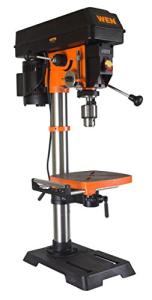
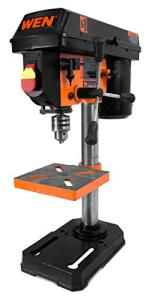
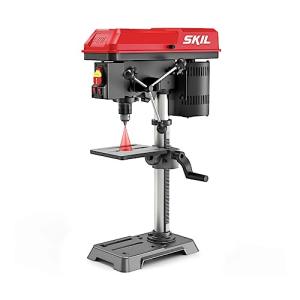
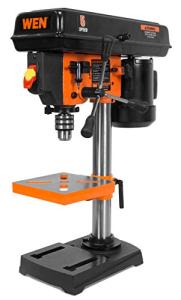
What Is a Drill Press and How Does It Work?
A drill press — also called a pillar drill or bench drill — is a stationary power tool designed to drive a rotating drill bit into a workpiece at a precise, controlled angle. Unlike a handheld drill, the drill press holds the bit in a perfectly vertical (or adjustable) orientation and moves it downward along a fixed column, so the hole you get is exactly where you aimed it and exactly as deep as you set it.
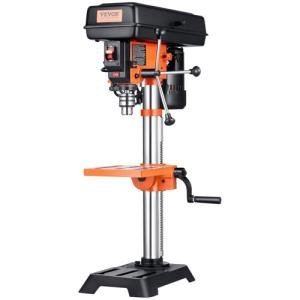
The core components of any drill press include:
- The column (or pillar): A thick steel post that provides the structural backbone of the machine. Everything mounts to or rides along this column.
- The head: Sits at the top of the column and contains the motor, the spindle, and the quill.
- The spindle and quill: The quill is the sleeve that moves up and down; the spindle rotates inside it and holds the chuck.
- The chuck: Grips the drill bit. Most drill presses use a keyed or keyless chuck with a 3-jaw design.
- The table: An adjustable platform where you secure your workpiece. It typically tilts up to 45 degrees left and right.
- The base: Sits on the floor or your workbench and provides stability for the whole assembly.
You lower the bit into the workpiece using a side handle connected to a rack-and-pinion or lever mechanism. It's simple, tactile, and satisfying — and because the movement is guided, the result is consistent every single time.
Types of Drill Presses
Not every drill press is built for the same job. The category spans a wide range of sizes and configurations, each suited to different working environments and tasks.
Benchtop Drill Presses
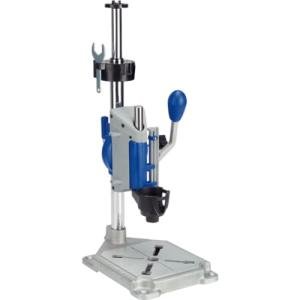
Benchtop models are compact units designed to sit on a workbench or stand. They're the most common choice for home workshops and hobbyists. They don't take up floor space on their own, they're easier to move around, and they're typically more affordable than their floor-standing counterparts.
That said, benchtop drill presses still offer excellent performance for most tasks. A quality benchtop unit can handle wood, soft metals, plastic, and composites without breaking a sweat. If your workspace is limited or you don't need to drill through very large workpieces, a benchtop press is almost always the right call.
Floor-Standing (Pedestal) Drill Presses
Floor-standing drill presses are larger, heavier machines with longer columns and bigger motors. They're designed for production environments, machine shops, or serious home shops where large workpieces need to be drilled regularly.
The longer column gives you more clearance beneath the head, which means you can work with taller stock. The heavier construction also reduces vibration, which improves hole quality — especially when drilling through metal.
Magnetic Drill Presses
Magnetic drill presses (also called mag drills) are specialized tools designed to drill into structural steel and other ferrous materials in the field. Instead of a fixed base, they use a powerful electromagnet to clamp the machine directly to the workpiece — which might be a steel beam, a tank, or a ship's hull.
These aren't shop tools in the traditional sense. They're worksite tools for construction, fabrication, and maintenance. If you're drilling large-diameter holes in steel structures, a mag drill is the right answer.
Radial Drill Presses
Radial drill presses feature an arm that can swing the drilling head horizontally, giving you a much wider reach than a standard column machine. They're common in industrial and production settings where large, heavy workpieces can't easily be repositioned under a fixed head.
For most home and small professional shops, a radial drill press is overkill — but if you regularly work with heavy stock that's awkward to move, the flexibility is invaluable.
Key Specifications to Understand Before You Buy
Drill press specs can look like alphabet soup if you don't know what to look for. Here's what actually matters.
Swing (Chuck-to-Column Distance)
Swing is the most commonly cited spec on drill presses, and it's slightly counterintuitive. It's not the distance from the chuck to the column — it's twice that distance. A 10-inch drill press, for example, has a 5-inch throat depth, meaning you can drill a hole at the center of a 10-inch-wide workpiece.
This spec tells you the maximum width of material you can drill through the center of. For most woodworking tasks, a 10-inch or 12-inch swing is perfectly adequate. For larger work, look at 15-inch or 17-inch machines.
Motor Power
Drill press motors are rated in amps or horsepower. For light woodworking and hobby use, a ½ HP motor handles most tasks fine. For regular metalworking or production use, look for ¾ HP or higher.
More horsepower isn't always better — a bigger motor in a machine with a poorly designed drive system doesn't help you. What matters is how the machine performs under load, which is where reading real-world reviews is more useful than comparing specs on paper.
Spindle Speed Range
Different materials require different drilling speeds. Wood can be drilled at high speeds; metal generally needs slower speeds to prevent overheating the bit and work hardening the material. The best drill presses offer a wide range of speeds — typically adjustable via a belt-and-pulley system or a variable speed electronic drive.
For a versatile shop press, look for a speed range that starts low (around 200–300 RPM) and goes up to at least 3,000 RPM. If you drill primarily metal, prioritize the lower end of the range.
Quill Travel
Quill travel — the distance the chuck can move up and down in a single stroke — determines how deep a hole you can drill without repositioning the workpiece. Most benchtop drill presses offer 2 to 3 inches of quill travel. Floor models often offer 4 to 5 inches.
For most drilling tasks this is plenty. But if you regularly drill deep holes or need to use long bits, pay attention to this spec.
Table Size and Adjustability
The table needs to be large enough to support your workpiece and adjustable enough to accommodate different stock thicknesses. Look for a table that raises, lowers, and tilts smoothly — and that has T-slots or holes for clamping fixtures. A wobbly, flimsy table is one of the most frustrating things about budget drill presses.
What Can You Do With a Drill Press?
The obvious answer is: drill holes. But that sells the tool short.
Woodworking applications are where most home drill press owners spend their time. Drilling perfectly perpendicular holes for dowel joinery, cutting mortises with a fence and stop, boring large-diameter holes with Forstner bits, and drilling consistent pocket holes all become faster and more accurate with a drill press.
Metalworking is where the drill press really earns its keep. Drilling through steel by hand is difficult and often produces ragged, off-angle holes. A drill press with the right speed settings and cutting fluid delivers clean, accurate holes in steel, aluminum, and brass every time.
Sanding and grinding — with drum sander attachments and sanding drums mounted in the chuck, a drill press doubles as a spindle sander for curved workpieces.
Routing and mortising — with the right accessories, some drill presses can be adapted for light mortising operations or even horizontal boring.
Plastic and composites — drill presses are excellent for acrylic, HDPE, carbon fiber, and other materials that need controlled feed rates to avoid cracking or delaminating.
Safety and Best Practices
A drill press is one of the safer power tools in the shop — but it still demands respect. A few rules that matter:
Always clamp your workpiece. This is non-negotiable. If the bit grabs and your hand is holding the stock, you'll know about it immediately. Use clamps, a vise, or a fence to secure work before you drill.
Adjust your table to minimize distance. The closer the table is to the chuck, the less leverage the bit has to catch and spin the workpiece if something goes wrong.
Match bit type to material. Twist bits, brad-point bits, Forstner bits, spade bits, hole saws — each is designed for specific materials and applications. Using the wrong bit wastes time and produces poor results.
Use cutting fluid on metal. Drilling steel dry is hard on bits and produces heat that can ruin both the bit and the work. A small amount of cutting oil makes a significant difference.
Keep the chuck key out of the chuck. If your press uses a keyed chuck, develop the habit of removing the key immediately after tightening. A chuck key left in a spinning chuck becomes a projectile.
Choosing the Right Drill Press for Your Needs
The right drill press depends entirely on what you're making and how much space you have.
For hobbyists and weekend woodworkers, a 10-inch or 12-inch benchtop drill press with a ½ HP motor and variable speed is hard to beat. Look for a well-built table with solid adjustment mechanisms and a cast iron head.
For dedicated woodworking shops, step up to a 15-inch or 17-inch floor-standing model with a larger table, more quill travel, and a stronger motor. The extra capacity and reduced vibration pay dividends in hole quality.
For metalworkers and fabricators, prioritize a slow-speed range, rigid construction, and a motor with real torque. A floor model with at least ¾ HP and a wide speed range is the starting point.
For mixed-use shops, a quality 12-inch to 15-inch benchtop or floor press with variable speed covers the broadest range of tasks.
Why a Drill Press Belongs in Every Workshop
There's a reason the drill press has been a workshop standard for over a century. It's not glamorous. It doesn't have the drama of a table saw or the versatility of a CNC router. But it does one thing — drilling accurate, repeatable holes — better than any other tool.
Whether you're building furniture, fabricating metal parts, working with plastics, or just making clean shelf holes in a cabinet, the drill press is the tool that makes precision feel effortless. Invest in a solid one, learn to use it well, and it will still be sitting in your shop twenty years from now, doing exactly what it's supposed to do.