Browse the full range of polishers and buffers below to find the right machine, pad selection, and accessories for your specific application.
Polishers & Buffers
Product List
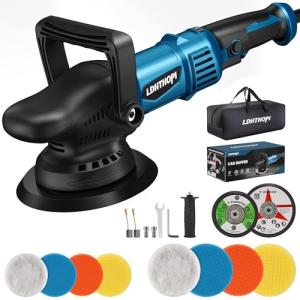
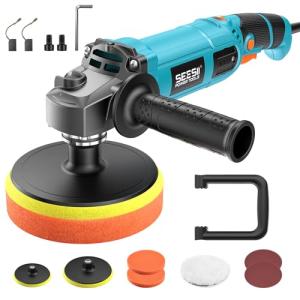
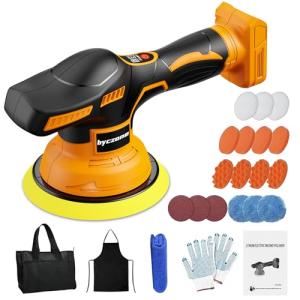
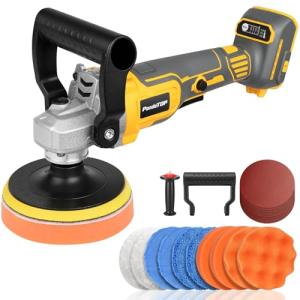
What Are Polishers and Buffers?
Polishers and buffers are power tools designed to apply, work in, or remove surface treatments — compounds, polishes, waxes, and sealants — at speeds and consistency that would be impossible by hand. They use rotating or oscillating pads to create the friction and heat needed to cut through surface imperfections, blend materials into a surface, or bring out a final shine.
The terms "polisher" and "buffer" are often used interchangeably, though there's a loose distinction worth knowing. A polisher typically refers to a tool used in the correction stage — cutting through oxidation, scratches, and swirl marks. A buffer tends to describe a tool used in the finishing stage — spreading wax, laying down a protective coating, or achieving that final high-gloss result. In practice, most modern machines can do both jobs depending on the pad and product you attach.
These tools show up everywhere from professional auto detailing shops and furniture restoration studios to metalworking benches, boat yards, and everyday home garages. They're not niche. Once you've used one properly, doing the job by hand feels pointless.
Types of Polishers and Buffers
Rotary Polishers
The rotary polisher is the original, the most powerful, and the one that demands the most respect. The pad spins in a single continuous circle, which generates significant heat and cutting power. In the right hands, a rotary machine can remove deep scratches and heavy oxidation faster than anything else. In the wrong hands, it can burn through paint or leave circular holograms that are worse than what you started with.
Rotary polishers are preferred by experienced detailers and body shop professionals for heavy correction work. If you're comfortable with the tool and understand how heat and pad pressure affect a surface, the rotary is unbeatable for serious restoration jobs.
Dual Action (DA) Polishers
The dual action polisher — sometimes called a random orbital polisher — is the most popular type on the market today, and for good reason. The pad moves in two motions simultaneously: it rotates on its own axis while also orbiting around a central point. This random, non-repetitive movement reduces heat buildup and makes it far harder to accidentally damage a surface.
DA polishers are genuinely beginner-friendly without being limited to beginners. They're the go-to tool for enthusiasts, detailing newcomers, and professionals who want to work efficiently without constantly babysitting heat levels. For the vast majority of car paint correction, waxing, and sealing tasks, a good DA polisher is all you'll ever need.
Forced Rotation DA Polishers
This is a hybrid between a rotary and a standard DA. Like a DA polisher, the pad oscillates in a random orbit — but unlike a standard DA, the pad rotation is mechanically forced rather than relying purely on friction. This means the pad keeps spinning consistently even under heavy pressure, which gives you more cutting power and better correction ability than a standard DA while remaining safer and more controlled than a pure rotary.
Forced rotation machines are a popular choice among professional detailers who want the safety margin of a DA with significantly more correction power, particularly for paint that has heavy defects or a hard, dense clear coat.
Gear-Driven Polishers
Gear-driven machines use an internal gear system to drive the pad in a fixed elliptical pattern. This produces more aggressive action than a free-spinning DA but with a different motion profile to a rotary. They're often used in professional settings for specific correction tasks. Less common for home use, but worth knowing about if you're comparing professional-grade machine specs.
Straight-Line Sanders and Polishers
For certain applications — particularly woodworking, large flat surfaces, and some metalworking tasks — a straight-line or reciprocating polisher moves the pad back and forth in a linear motion rather than a circular one. This avoids the swirl marks that rotary or orbital motion can leave on softer materials and is preferred for finishing furniture, flooring, and similar surfaces.
Bench-Mounted Buffing Machines
Bench polishers hold one or two buffing wheels on a motorised spindle. The workpiece is brought to the machine rather than the machine being taken to the workpiece. These are the standard setup for jewellery polishing, knife and blade finishing, metal fabrication work, and any application where you're working with smaller objects that need consistent, controlled contact with a spinning buff. The wheels themselves come in a wide range of materials — sisal, cotton, felt, muslin — each suited to different stages of the polishing process.
Key Specifications to Understand
Orbits Per Minute (OPM) and Revolutions Per Minute (RPM)
Speed matters, but context matters more. A machine running at 6,000 OPM with a 15mm throw (the diameter of the orbital motion) generates significantly more surface speed than one running at the same OPM with a smaller throw. For polishing car paint, you generally want adjustable speed so you can dial down for delicate stages and push harder for correction work. Most quality DA polishers offer variable speed control in the 1,500 to 6,500 OPM range.
Backing Plate and Pad Size
The diameter of the backing plate determines the pad size you'll be using, which in turn affects coverage, maneuverability, and the force concentrated on any given area. Larger pads (150mm to 180mm) cover ground quickly and are great for flat panels. Smaller pads (80mm to 125mm) are better for curved surfaces, tight areas around trim, and targeted spot correction work. Many professionals keep multiple machine and pad size combinations for different stages of a job.
Throw Size
On DA polishers specifically, the throw — sometimes called the orbit size — describes the diameter of the circular orbit the pad makes. A larger throw (21mm or more) moves more product across the surface and is efficient for applying polishes and waxes. A smaller throw (8mm to 15mm) concentrates the work in a tighter area and is generally better for correction work, as it allows for more precise paint defect removal.
Motor Power
Measured in watts or amps, motor power determines how the machine handles under load. A polisher with an underpowered motor will bog down the moment you apply reasonable pad pressure, which both slows your work and leads to uneven results. For automotive paint work, a machine in the 500W to 900W range is a reasonable benchmark for serious use. Professional rotary machines often exceed this significantly.
Choosing the Right Pads
No polisher does useful work without the right pad attached to it. Pads come in foam, microfibre, wool, and hybrid constructions, each designed for a specific role in the polishing process.
Cutting pads are denser and more aggressive — they're used with compound or heavy polish to remove scratches, swirls, and oxidation. Polishing pads are softer and less abrasive, used with lighter polish to refine the surface after cutting. Finishing pads are the softest of all, designed for applying waxes, sealants, and glazes for a final high-gloss result.
Microfibre pads offer a different cutting mechanism — tiny fibres acting more like a very fine abrasive than a foam surface — and are often praised for cutting efficiency with less product use. Wool pads are typically found in heavy correction work and bench polishing applications.
The pad material, the machine type, and the product you're using all interact. A finishing pad on a rotary at high speed with a cutting compound will produce very different results to a cutting pad on a DA at low speed with a light polish. Understanding these combinations is what separates a good result from a great one.
Polishers for Specific Applications
Automotive Detailing
This is where the polisher and buffer market is deepest and most developed. From removing light swirl marks with a DA and polishing pad to carrying out full paint correction on heavily oxidised or scratched clear coats, there's a dedicated machine, pad, and product for every step. Automotive polishing is also where technique matters most — working in straight overlapping passes, keeping the pad flat on the surface, and monitoring heat are all essential habits.
Metalworking and Fabrication
Bench buffing machines are workhorses in metal shops. Aluminium, stainless steel, brass, and chrome all respond to buffing with the right compounds and wheels, going from raw or brushed finishes to near-mirror surfaces. Angle grinder polishing attachments are also widely used for larger metal surfaces where a bench machine isn't practical.
Woodworking and Furniture
Straight-line machines and random orbital sanders cross over heavily with polishing work in woodworking. Applying and buffing finishing oils, lacquers, and waxes on furniture and floors requires a different approach to automotive work — slower speeds, softer pads, and products formulated for porous surfaces.
Boat and Marine
Marine surfaces face a uniquely harsh environment. Oxidised gelcoat on fibreglass hulls is a common restoration task, and the scale of the surfaces involved makes a powerful, reliable polisher essential rather than optional. Rotary and forced-rotation DA machines are both used extensively in marine detailing.
Safety and Best Practices
Working with any powered polishing machine involves moving parts, surface heat, and product splash. Eye protection is non-negotiable when using rotary machines or bench buffers. Keep cables and yourself clear of the rotating pad. Never operate a buffing machine without securing loose clothing and ensuring long hair is tied back.
For paint correction work specifically: always work in a controlled environment where you can see the surface clearly, start with the least aggressive product and pad combination that will do the job, and always work with a clean pad — contaminated pads introduce new scratches rather than removing old ones.
Polishers and buffers are among the most satisfying tools to use well. The ability to take a dull, scratched, or tired surface and transform it through controlled mechanical action and the right products is a genuinely rewarding skill. The investment in understanding the tool types, matching the right pad and product to the job, and taking time to learn correct technique pays off quickly in results that are noticeably better than anything achievable by hand.