What Is a Jointer and What Does It Actually Do?
A jointer is a stationary woodworking machine designed to create perfectly flat surfaces and straight edges on rough or warped lumber. You pass a board over a rotating cutterhead — a spinning cylinder fitted with sharp blades — while the infeed and outfeed tables guide the workpiece through the cut. The infeed table sits slightly lower than the outfeed table, and that height difference determines how much material gets removed with each pass.
The result? Boards that lie dead flat, edges that are arrow-straight, and surfaces that are truly square to each other. These are the qualities that make every downstream task — ripping, planing, gluing, assembling — go the way it should.
There are three fundamental jointing operations most woodworkers use regularly:
Face jointing flattens one face of a board, removing twist, cups, and bows from rough-sawn lumber. This is usually your first step with any new board.
Edge jointing straightens and squares one edge of a board, so it's both straight along its length and perfectly perpendicular to the flat face you just created. This is what makes glue joints invisible.
Bevel cutting uses the adjustable fence, tilted to any angle up to 45 degrees, to cut consistent beveled edges across multiple boards.
Types of Jointers: Finding the Right One for Your Shop
Not all jointers are built the same, and the differences matter. Understanding the main categories helps you match a machine to your actual needs rather than buying more — or less — than your work demands.
Benchtop Jointers
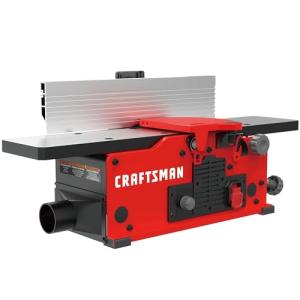
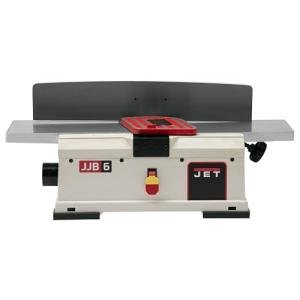
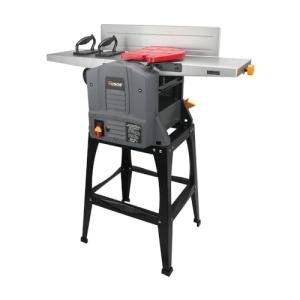
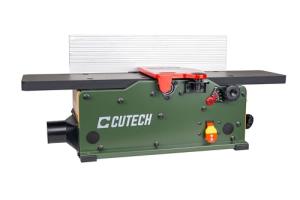
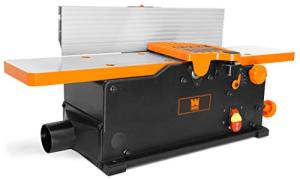
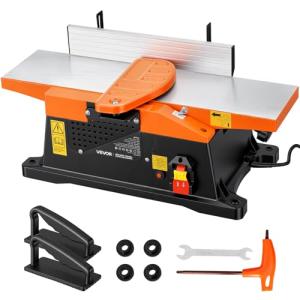
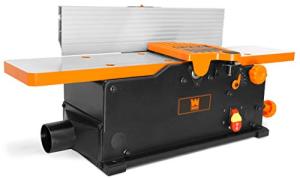
Benchtop jointers are compact, lightweight machines designed to sit on a workbench or rolling stand. They typically have 6-inch wide tables and 10-amp motors, making them ideal for hobbyists, small-shop woodworkers, and anyone working in a garage where floor space is limited.
Don't let their size fool you. Modern benchtop jointers — especially those equipped with spiral cutterheads — deliver genuinely impressive results on boards up to 6 inches wide. They're the go-to choice for furniture makers working on a smaller scale, and they're portable enough to move when you need the floor space for something else.
Floor-Standing Jointers
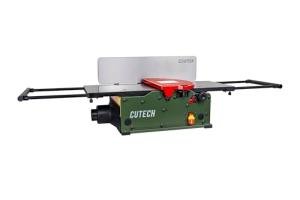
Floor-standing models are the workhorses of professional shops. With table widths of 8, 10, or 12 inches and significantly more powerful motors, these machines handle the demands of daily production work without breaking a sweat. Their heavier cast iron construction reduces vibration, which directly translates to smoother finished surfaces.
If you regularly work with wide panels, hardwoods like maple and walnut, or you're running stock every day, a floor-standing jointer isn't just a luxury — it's a time-saving investment that pays for itself in quality and efficiency.
Jointer/Planer Combination Machines
For shops where space is genuinely tight, combination jointer-planer machines offer the functionality of both tools in a single footprint. You get a jointer surface on one side and a planer on the other, with a shared cutterhead doing the work.
The trade-off is setup time when switching between modes, and most combination machines sacrifice some capacity compared to dedicated machines at the same price point. But for a small shop that needs both tools and can only fit one, they're a smart, practical solution.
Cutterhead Types: Straight Knives vs. Helical/Spiral
The cutterhead is the heart of any jointer, and the type you choose has a real impact on the quality of your results, your maintenance routine, and even how loud the machine is.
Straight Knife Cutterheads
Traditional jointers use a cutterhead with two or three straight, high-speed steel (HSS) knives running the full width of the machine. These are the most common and least expensive design, and they cut aggressively and fast.
The catch is maintenance. Straight knives dull relatively quickly, especially on hardwoods or boards with silica deposits, and setting them correctly after sharpening requires patience and a good eye. When a knife chips on a hidden nail or staple, the entire blade needs replacing — or you live with a small track mark in every board until you do.
Helical and Spiral Cutterheads
Spiral and helical cutterheads have become the preferred choice for serious woodworkers, and it's easy to see why. Instead of long straight knives, these heads use dozens of small, square carbide inserts arranged in a spiral pattern around the cutterhead cylinder. Each insert makes a shearing cut at a slight angle, which dramatically reduces tear-out on figured grain, hardwoods, and difficult species.
The practical benefits stack up fast. Carbide inserts last far longer than steel knives. When an insert gets damaged, you simply rotate it to a fresh corner — no grinding, no lapping, no setup hassle. The cutting action is quieter (often noticeably so) and produces smaller chips that your dust collector handles more effectively. And the surface quality? Consistently smooth, with far less sanding required afterward.
Key Features to Evaluate When Buying a Jointer
Shopping for a jointer means weighing several specifications that directly affect how the machine performs in your hands.
Table Width
Table width determines the widest board you can flatten or joint in a single pass. A 6-inch jointer handles most furniture parts and smaller cabinet components. An 8-inch machine covers a much wider range of work without repositioning boards. A 10 or 12-inch jointer opens up wide panel work, solid-wood slabs, and large cabinet parts.
Buy for the work you actually do — or plan to do within the next few years. Undersizing now creates frustrating limitations later.
Table Length
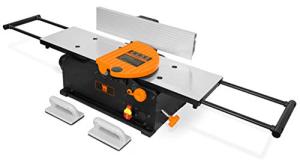
Longer tables give you more support on both sides of the cutterhead, which means better control over longer boards and more accurate results overall. A short infeed table lets boards sag before they reach the cutterhead, creating subtle errors that add up in assembly. Look for combined infeed and outfeed table lengths of at least 60 inches for general workshop use.
Motor Power
Motor size is measured in amps (for 120V machines) or horsepower (for larger 240V units). A 10-amp benchtop jointer is adequate for softwoods and lighter hardwoods. For consistent work in dense species like hard maple, cherry, or white oak, more power translates directly to smoother cuts and a machine that doesn't bog down mid-pass.
Fence Quality and Adjustability
The fence guides your board through the cut and determines whether your edges come out square. A good fence is heavy, rigid, moves smoothly across the full width of the table, and locks solidly in position. Adjustable positive stops at 90 and 45 degrees are a standard feature worth verifying. Sloppy fences produce sloppy edges — no amount of technique makes up for it.
Depth-of-Cut Adjustment
Precise, repeatable depth-of-cut adjustment is more important than it sounds. Being able to set exactly 1/32" or 1/16" of removal per pass — and get that same setting every time — gives you control over how quickly you work through a board without creating problems with snipe or surface quality.
Jointers and Planers: The Classic One-Two Combination
Here's something every woodworker eventually learns: a jointer and a thickness planer work together, not independently. The jointer creates one flat reference face and one straight reference edge. The planer then uses those references to machine the opposite face perfectly parallel, bringing the board to uniform thickness across its full width.
Without the jointer's flat reference face, a planer simply copies whatever twist or cup is already in the board, scaled evenly across both faces. You end up with a board that's the same thickness everywhere — but still not flat.
If you're building furniture or cabinetry from solid wood, eventually adding both tools is one of the highest-impact upgrades you can make to your shop.
Getting the Most from Your Jointer: Practical Tips
Even the best jointer only works as well as the technique used with it. A few habits make a measurable difference in the quality of results.
Always joint with the grain. Running a board against the grain direction causes tear-out, regardless of how sharp your knives are. Look at the grain direction on the edge of the board and feed it so the grain is running "downhill" into the cut.
Use light passes on figured wood. Heavily figured grain — bird's eye maple, curly cherry, quilted maple — wants shallow cuts, around 1/32" or less per pass. Aggressive cuts on figured wood produce tear-out that can take significant sanding to recover from.
Let the outfeed table do the work. The outfeed table is your reference surface. Once the leading edge of a board contacts the outfeed table, keep downward pressure there — not on the infeed side. This is the fundamental technique for producing a truly flat surface.
Keep your cutterhead clean and sharp. Resin and pitch build up on cutterheads over time, especially with pine and other resinous softwoods. A quick cleaning with a resin remover spray keeps the machine cutting cleanly and extends the life of your blades.
Use push blocks. When jointing narrow or short pieces, push blocks keep your hands safely away from the cutterhead while maintaining consistent downward and forward pressure. This is a safety non-negotiable, not a suggestion.
Who Needs a Jointer?
The short answer is: anyone working regularly with solid wood.
Furniture makers rely on jointers to prepare stock before assembly. Cabinet builders use them to produce the seamless glue lines that define quality work. Woodturners who work with square blanks benefit from the flat, square starting points a jointer provides. Even flooring installers and trim carpenters find jointers invaluable for fitting custom work precisely to a space.
If your projects consistently involve solid lumber — not just sheet goods — a jointer removes the most frustrating variable from the process: lumber that won't cooperate. Flat stock behaves predictably at every stage, from the first rip cut to the final glue-up.
Start with flat, straight, and square — everything you build from there will be better for it.