What Are Shears and Nibblers?
At their core, both shears and nibblers are designed to cut through sheet metal quickly and efficiently — far faster and less fatiguing than hand tools. But they achieve that goal in very different ways, and those differences matter enormously depending on the material you're working with and the type of cut you need to make.
Shears work like a powerful pair of scissors. A moving blade cuts against a fixed anvil blade, slicing cleanly through the metal. No material is actually removed in the process — the shear simply separates the sheet along the cut line. This makes shears incredibly clean and efficient, producing minimal waste.
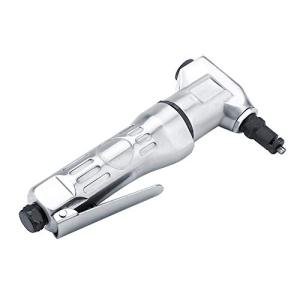
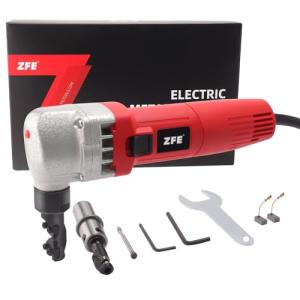
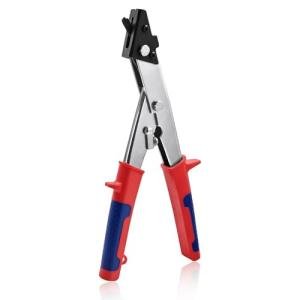
Nibblers, on the other hand, work more like a very fast, mechanical punch. A reciprocating punch strikes repeatedly against a die, literally chewing out small chips of material as the tool moves forward. The name says it all — a nibbler nibbles its way through metal, biting out tiny pieces with each stroke.
Both approaches have genuine strengths. Understanding those strengths is everything.
Types of Metal Shears
Not all shears work the same way. There are two main types you'll encounter in this category, and they suit different applications.
Single-Cut Shears
Single-cut shears operate with one moving blade cutting against a stationary blade. Think of the heaviest-duty scissors you can imagine. These are the workhorses of the shear family — capable of cutting through the thickest gauge materials, including mild steel up to around 3mm, as well as copper, brass, aluminium, and lead.
The trade-off is that single-cut shears can distort the metal along the cut line. The shearing force naturally bends one side of the cut, which can be an issue if you need both pieces to remain perfectly flat. They can navigate curves, though they require a wider turning radius than nibblers. For straight cuts and large-radius curves on heavy material, single-cut shears are hard to beat.
Double-Cut Shears
Double-cut shears use two blades that work together, removing a narrow strip of material rather than simply separating two pieces. That thin strip of waste is the price you pay for a significantly cleaner cut. Double-cut shears produce far less distortion in the surrounding metal, making them the preferred choice when flatness and precision matter as much as speed.
They're particularly well-suited for lighter gauge sheet metal — typically up to 18-gauge — and they excel at HVAC ductwork, automotive bodywork, metal signage, and roofing panels where the cut needs to stay straight and the metal needs to stay flat. They're not built for heavy-duty cutting the way single-cut shears are, but for the applications they're designed for, they're outstanding tools.
Swivel Head and Offset Shears
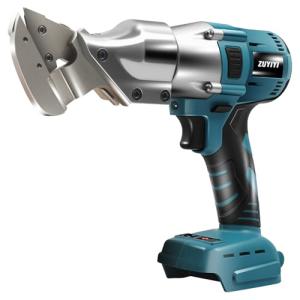
Many modern shears come with swivel heads that can be repositioned at different angles, giving you greater control when working in tight spaces or awkward orientations. Offset shears take this a step further, positioning the cutting head offset from the body of the tool so that your hand stays well clear of the material and your knuckles don't scrape along the sheet as you cut. If you're doing a lot of bench work or cutting on flat sheets, an offset design is genuinely worth considering for comfort and safety alone.
Types of Nibblers
Nibblers are a more homogeneous category, but there are still a few meaningful variations worth knowing about.
Standard Nibblers
Standard nibblers use a punch-and-die assembly that strikes rapidly to chew through the material. The die in many nibblers is capable of rotating, which is a practical advantage when cutting corrugated or trapezoidal sheet metal — a common challenge in roofing work. Because the die rotates, it can follow the ridges of corrugated sheets without jamming or distorting the profile, making nibblers the go-to tool for metal roofing installation and repair.
Standard nibblers are also well-suited for cutting complex shapes, interior cutouts, and intricate patterns. If you need to start a cut in the middle of a sheet rather than from an edge, you can drill a small starter hole and insert the nibbler — something that's awkward or impossible with most shears.
Attachment Nibblers
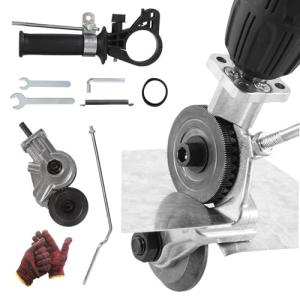
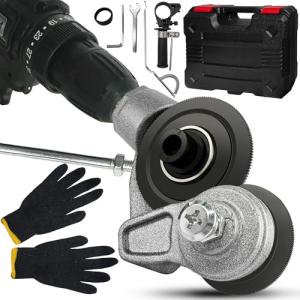
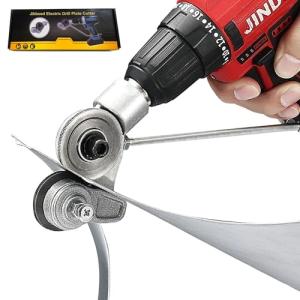
A popular and cost-effective option, attachment nibblers fit onto a standard power drill or angle grinder. They're a great way to add nibbling capability to a kit you already own without investing in a dedicated tool. Performance is naturally more limited than a purpose-built nibbler, but for occasional use or lighter gauge work, they deliver solid results.
Shears vs. Nibblers: Which Should You Choose?
This is the question most buyers have when they arrive in this category, and the honest answer is: it depends on your application. Here's a practical breakdown.
Choose shears when:
- You're cutting thin gauge sheet metal (up to around 18-gauge for double-cut, heavier for single-cut)
- You need clean, precise, burr-free cuts
- Your cuts are primarily straight lines or large-radius curves
- Keeping the cut metal flat and undistorted is a priority
- You're working with HVAC ductwork, automotive panels, or metal signage
Choose nibblers when:
- You're working with corrugated or trapezoidal sheet metal
- You need to cut tight curves, complex shapes, or intricate patterns
- You need to make interior cutouts without access to an edge
- You're working on large-scale roofing or cladding projects
- Material thickness is on the heavier side
- You're a sculptor or creative metalworker cutting artistic shapes from sheet metal
One point worth noting: nibblers produce thousands of small metal chips as they cut. These chips are sharp, they scatter widely, and they can damage flooring, scratch surfaces, and even cause short circuits if they get into machinery. Good chip management — using magnets, keeping the work area clear, wearing proper PPE — is essential when using a nibbler.
Shears, by contrast, produce virtually no debris (double-cut shears produce a thin strip of waste, but it's easy to manage). For indoor environments, workshops with sensitive equipment, or jobs where cleanliness matters, shears are generally the tidier choice.
Corded vs. Cordless: Power Options Explained
Both shears and nibblers are available in corded and cordless versions, and the choice between them follows the same logic as any other power tool.
Corded models deliver consistent, unlimited power without any concern about battery life. If you're doing extended production runs, working in a fixed workshop environment, or tackling very heavy-gauge material, a corded tool will never let you down mid-cut. They tend to be more affordable in the initial purchase price as well.
Cordless models have improved dramatically in recent years, with major brands like Milwaukee, DeWalt, Makita, Metabo, Bosch, and Fein all offering impressive 18V and 20V MAX nibblers and shears that can handle professional-grade workloads. The freedom of movement a cordless tool provides is genuinely valuable on roofs, scaffolding, and large job sites where dragging a cord around creates hazards and slows you down. If you're already invested in a particular battery platform, adding a cordless nibbler or shear to your kit is a natural extension.
Key Specs to Check Before You Buy
When shopping for a shear or nibbler, a handful of specifications will tell you most of what you need to know.
Maximum cutting capacity is listed in gauge or millimetres for specific materials — mild steel, stainless steel, and aluminium typically all have different rated capacities for the same tool. Make sure the tool you're considering is rated for the material and thickness you'll be cutting most often.
Strokes per minute (SPM) tells you how fast the cutting mechanism cycles. Higher SPM generally means faster cutting and a cleaner finish, particularly with nibblers.
Minimum cutting radius matters if you need to cut tight curves. Nibblers almost always outperform shears here, but some models are more agile than others.
Blade/die replacement is something many buyers overlook until they're in the middle of a job with a worn-out cutting edge. Check how easy it is to replace blades or punch-and-die sets, and make sure replacement parts are readily available and affordable for the model you choose.
Ergonomics and handle design — particularly the presence of a swivel head, adjustable die position, or offset grip — can make a significant difference over a long day of cutting. Don't underestimate comfort as a buying factor.
Popular Brands in This Category
The shears and nibblers market is well-served by trusted professional brands. Milwaukee is a standout in the cordless space, with their M18 range covering both single-cut shears and nibblers built for demanding job sites. DeWalt offers a strong lineup of 20V MAX swivel-head shears in both single-cut and double-cut variants. Makita brings reliable 18V LXT options including fibre cement shears. Metabo and Bosch both produce high-quality cordless shears with brushless motors for extended tool life. Fein is well regarded for nibblers, particularly for corrugated sheet applications where precision and build quality matter. For corded heavy-duty applications, brands like Kett Tool and CS Unitec serve professional fabrication environments well.
Applications: Where Shears and Nibblers Get Used
The range of industries and trades that rely on shears and nibblers is broader than you might expect.
- Roofing and cladding — nibblers handle corrugated metal roofing panels with ease; shears tackle flat roofing sheet cleanly
- HVAC installation — shears are standard for cutting ductwork and ventilation components
- Automotive bodywork — both tools are used for cutting panels, patches, and custom bodywork
- Steel framing and construction — shears cut structural sheeting and metal stud components efficiently
- Metal fabrication and prototyping — nibblers enable complex shapes and small-batch production
- Creative metalworking and art — nibblers are popular with sculptors and artists for their ability to navigate intricate cuts
- DIY home renovation — both types are used for flashing, fascia, custom metalwork, and general sheeting tasks
Shears and nibblers aren't competing tools — they're complementary ones. Many professionals who work with sheet metal regularly keep both in their kit, reaching for each in the situations it handles best. If budget or kit size forces you to choose one, think carefully about the materials you cut most often, the gauge range you work in, and whether clean flat cuts or complex curved shapes are your priority.
The right tool doesn't just make the job easier. It makes the finished result better. Browse our full range of shears and nibblers to find the right match for your work.