What Are Concrete Tools?
Concrete tools are the specialized hand tools, power equipment, and finishing instruments used at every stage of working with concrete and cement-based materials. That includes mixing, pouring, leveling, finishing, cutting, and curing.
This isn't the same as general masonry tools, though there's some overlap. Concrete tools are designed specifically for the unique demands of fresh and cured concrete — its weight, its workability window, its abrasiveness, and the precision required to get a clean, durable result.
The category breaks down into several core groups: mixing tools, placing and screeding tools, finishing tools, edging and jointing tools, curing tools, and cutting and breaking tools. Each group plays a distinct role in the workflow, and skipping any one of them tends to show up in the finished product.
Mixing Tools — Where Every Job Starts
You can't do anything with concrete until it's properly mixed. Under-mixing leaves dry pockets that weaken the slab. Over-mixing introduces too much air. Getting the ratio of water to mix right is half the battle, and having the right mixing tools makes it repeatable.
Mixing Paddles and Drill Attachments
For small batches — repair mortars, patch compounds, or bagged concrete mix for fence posts — a heavy-duty mixing paddle attached to a corded drill or a dedicated mixer drill gets the job done quickly. These paddles come in different configurations depending on whether you're mixing thin slurries or stiff mortar. Look for paddles made from heavy-gauge steel with a rust-resistant coating; concrete is alkaline and will corrode cheap metal fast.
Concrete Mixers
For anything bigger than a few bags, a drum mixer is essential. Portable electric mixers in the 1.5 to 3.5 cubic foot range handle residential pours like footings, small slabs, and steps. Towable gas-powered mixers step things up for contractors working without a nearby outlet or handling larger continuous pours. The drum design matters — look for a mixer that tilts fully for clean discharge and has blades positioned to prevent dry pockets from forming at the base.
Mixing Hoes and Mud Tubs
Sometimes the old ways hold up. A mortar hoe — that wide rectangular blade with two holes punched through it — is still one of the fastest tools for hand-mixing small batches in a mortar tub. The holes allow material to pass through on both the push and pull stroke, which dramatically reduces mixing time compared to a standard flat hoe. A good mortar tub, meanwhile, gives you a stable, contained workspace that cleans up easily and doubles for transporting mixed material short distances.
Placing and Screeding Tools — Getting Concrete Where It Needs to Go
Once the concrete is mixed, you've got a limited window to place and level it before it starts to set. Speed matters here, and so does accuracy.
Concrete Rakes and Come-Alongs
A concrete rake — sometimes called a come-along — is a wide, flat blade with a short tyne pattern designed to pull and distribute fresh concrete across a form without disturbing the aggregate structure. Unlike a garden rake, these tools move material efficiently without dragging the heavier aggregate to the surface, which would weaken the top layer of the slab. Contractors working on larger pours often keep two or three of these on hand so multiple crew members can spread concrete simultaneously as it's being discharged from the truck.
Screed Boards and Roller Screeds
Screeding is the process of striking off excess concrete to bring it to the level of the form edges. A traditional screed board is nothing more than a straight piece of lumber or aluminum pulled back and forth across the wet concrete in a sawing motion. Simple, effective, and cheap.
Roller screeds — a rotating tube pulled across the surface — take less effort and produce a more consistent result, especially on wider pours. Vibrating screeds go one step further by consolidating the concrete as they level it, pushing air bubbles out and drawing the heavier aggregate slightly downward. For professional flatwork, a vibrating screed is one of the best investments you can make.
Finishing Tools — The Difference Between Good and Great
This is where concrete work becomes craft. Finishing determines the texture, durability, and appearance of the final surface. The tools here require practice, but they reward it.
Bull Floats and Darby Floats
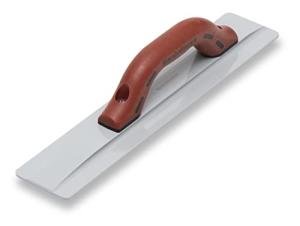
Immediately after screeding, a bull float or darby is used to flatten the surface and embed any aggregate that's sitting too high. A bull float — a wide, flat magnesium or aluminum blade on a long handle — is pushed and pulled across the surface to close up voids left by the screed. Magnesium floats work better for air-entrained concrete because they don't suction to the surface the way wood does.
A darby is a shorter, two-handled version used for smaller slabs or areas where a bull float is awkward. Both tools are used before bleed water rises to the surface — working concrete before that water evaporates traps it in the top layer and causes scaling.
Hand Floats and Trowels
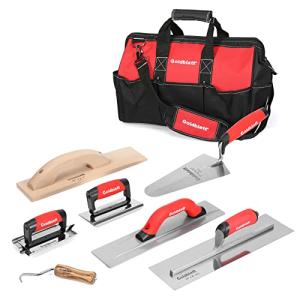
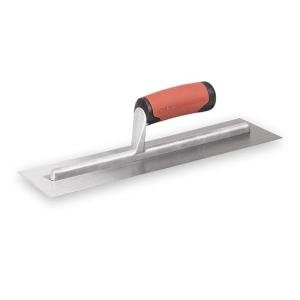
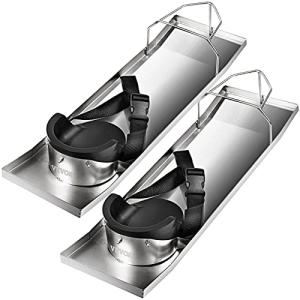
Once the bleed water has evaporated and the concrete has firmed up enough to support a finisher's weight on knee boards, hand floats and trowels take over. A hand float opens the surface slightly and levels minor imperfections. A steel finishing trowel then burnishes the surface to the desired smoothness, from a light sand texture to a hard, mirror-like finish.
Trowel work is progressive — you make multiple passes as the concrete stiffens, applying more pressure each time. The timing is everything. Too early and you push wet material around. Too late and you're fighting a surface that's already set.
Power Trowels
On larger slabs, hand troweling alone isn't realistic. Walk-behind power trowels — sometimes called "helicopters" — use rotating blades to cover ground much faster than hand finishing. Ride-on power trowels handle warehouse floors, parking structures, and other large commercial pours. These machines require training to use correctly, but the consistency and speed they offer make them indispensable on professional jobs.
Edging and Jointing Tools — Control Where the Cracks Go
Concrete cracks. This isn't a defect — it's physics. As concrete cures and shrinks, stress builds up, and eventually it has to go somewhere. Edging and jointing tools let you control exactly where that happens.
Concrete Edgers
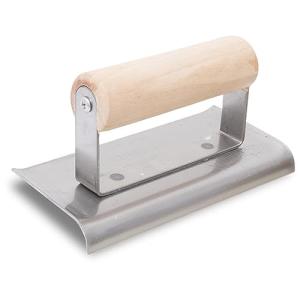
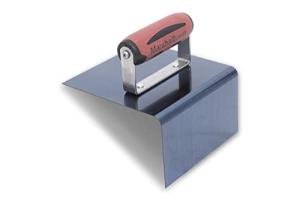
An edger is run along the perimeter of a slab while the concrete is still workable to create a rounded or beveled edge. This serves two purposes: it looks cleaner than a sharp, ragged edge, and it's far less prone to chipping and spalling over time. Edgers come in various radius sizes, and the choice depends on the look you're going for and the application.
Groover and Jointing Tools
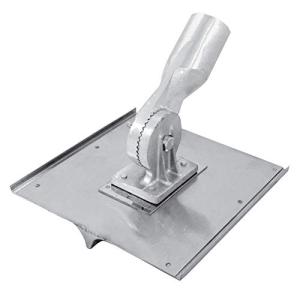
Control joints — the grooves you see running across driveways and sidewalks at regular intervals — are created with a hand groover or a circular saw fitted with a diamond blade. Hand groovers are pushed through fresh concrete to cut a groove at least one-quarter the depth of the slab. When the concrete cracks from shrinkage stress, it cracks along this weakened line rather than randomly across the surface. Proper joint placement is one of the most important factors in a slab's long-term appearance and performance.
Curing Tools — Don't Walk Away Too Soon
Curing is the process of keeping concrete moist and at the right temperature while it gains strength. Concrete doesn't "dry" — it hydrates. If it dries out too fast, it loses strength dramatically. Curing tools help protect the investment of time and material already made.
Curing Compounds and Applicators
Liquid curing compounds are sprayed onto the finished surface immediately after final troweling to seal in moisture. A pump-up garden sprayer works fine for small areas; a backpack sprayer or wheeled spray rig covers larger slabs more efficiently. The compound forms a thin membrane that slows evaporation while the concrete gains strength over the following days and weeks.
Burlap, Plastic Sheeting, and Wet Curing Tools
Covering fresh concrete with wet burlap or plastic sheeting is the most reliable curing method in many conditions, especially in hot or windy weather where evaporation is rapid. In cold weather, insulating blankets prevent freezing during the early curing period. These aren't glamorous tools, but skipping proper curing is one of the most common reasons concrete underperforms over its lifespan.
Cutting and Breaking Tools — For When Concrete Needs to Come Out
Not every concrete job is about putting it in. Repairs, renovations, and demolition require cutting through cured concrete cleanly or breaking it up for removal.
Diamond Blade Angle Grinders and Circular Saws
For cutting control joints after the fact, trimming edges, or making precision cuts through cured slabs, a diamond blade fitted to an angle grinder or circular saw is the standard approach. Wet cutting with water reduces dust dramatically and extends blade life. Dry cutting blades are more convenient but produce significant silica dust — proper respiratory protection is non-negotiable.
Demolition Hammers and Breakers
Electric demolition hammers handle everything from removing old tile set in mortar beds to breaking up small slabs. For larger demolition work — busting out a full driveway or removing a thick foundation section — a gas or electric jackhammer delivers the impact energy needed to work efficiently without destroying yourself physically in the process.
Choosing the Right Concrete Tools for Your Project
The right tool selection depends on three things: the scale of the job, the finish you're after, and your budget.
For small residential repairs and DIY pours under a cubic yard, quality hand tools — a mixing tub, good screed board, bull float, edger, and a pair of steel trowels — will take you a long way. Rent a plate compactor and a wet saw when you need them rather than buying.
For contractors doing regular flatwork, investing in professional-grade aluminum and magnesium floats, a vibrating screed, and eventually a walk-behind power trowel pays back quickly in speed and quality. Commercial-grade tools also hold up to the abuse of a working environment far better than consumer versions.
Whatever your level, buy the best tools you can afford for the items you'll use on every job — trowels, floats, and mixing paddles especially. Cheap finishing tools make clean, consistent work harder to achieve. Better tools don't guarantee better results, but they remove a variable that can work against you.
Maintaining Your Concrete Tools
Concrete is unforgiving to tools left dirty. Even partially cured residue left on a trowel, float, or mixing drum will harden and ruin the tool's working surface. Wash everything with clean water immediately after use. Stiff brushes and plastic scrapers handle most residue without scratching metal surfaces. For heavily cured buildup, a dilute muriatic acid solution removes it quickly — wear gloves and eye protection, rinse thoroughly, and dry the tools before storage to prevent rust.
Store steel trowels flat or hanging, never stacked face-down. Keep wooden handles lightly oiled if they'll sit unused for a season. A few minutes of proper cleanup and storage after every job means your tools are ready to perform at their best the next time you need them.
Concrete work rewards preparation and punishes shortcuts. Having the right tools on hand before the truck arrives or the bags get opened is the single most controllable factor in how a job turns out. Browse the full selection in this category to find exactly what your next project requires.